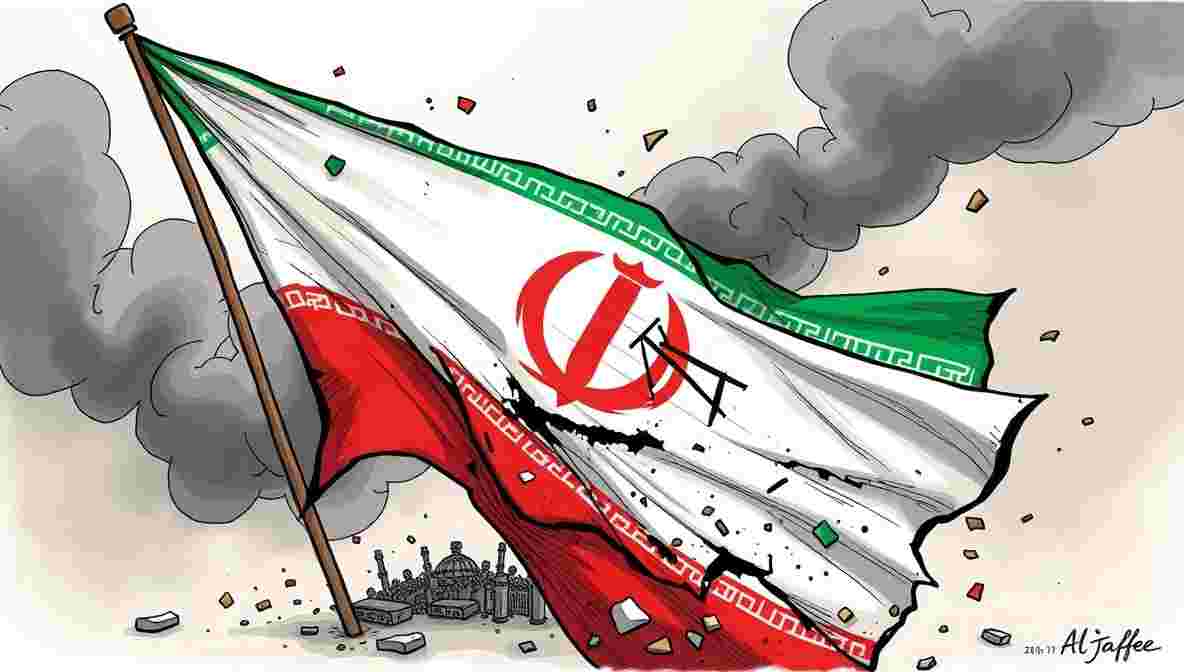
The Airman Came Home. So Did Trump’s War Momentum.
A daring rescue deep inside Iran saved a life on Saturday. For many Americans who hoped this war might end through talks, not glory, the news landed with a particular weight.
The colonel came home on Saturday night, and the celebration was immediate and loud. President Trump announced the rescue of a downed F-15E weapons systems officer from inside Iran in a post that read, in full capital letters: “WE GOT HIM!” Cable news lit up. Defense officials spoke of “dozens of aircraft.” A retired general called it something “no one in the world” but the United States could pull off.
Every word of that is probably true. The operation, by all accounts, was genuinely remarkable — a commando raid deep into Iranian territory, a CIA deception campaign to misdirect Iranian search parties, two transport aircraft deliberately destroyed to prevent capture, and every American home safe by midnight local time. The airman had spent nearly 48 hours in a mountain crevice, armed with a handgun, with a bounty on his head. He deserved to come home.
But here is the harder thing to say out loud: for the millions of Americans — and the tens of millions of people around the world — who had hoped this war might find an off-ramp, Saturday was a bad day dressed up as a good one.
What the Rescue Means Politically
Wars have rhythms. They have moments that shift public opinion, that harden political will, that make negotiated endings feel like surrender rather than wisdom. The rescue of a single soldier — brave, real, undeniable — is exactly that kind of moment. It is a human story that crowds out every complicated question about why we are here, how we got here, and what comes next.
Trump understood this instantly. He has spent the past week reminding Iran that Monday evening brings his deadline — reopen the Strait of Hormuz or face “all Hell.” The rescue, coming 36 hours before that deadline, hands him a narrative that is nearly impossible to argue against in the short run. He took a risk. The military executed. The airman lived. The crowd roars.
Critics of this war — those who argued from the beginning that a negotiated nuclear deal would have been preferable to bombs, that regional stability should have been the priority, that the civilian cost inside Iran deserved more weight in Washington’s calculus — find themselves in a corner. Not because their arguments are wrong, but because Saturday made those arguments sound abstract against a very concrete human story.
The War’s Other Costs, Still Uncounted
While the rescue dominated every headline, the broader picture of this conflict remained grim and largely invisible to the American public.
NetBlocks, the internet monitoring organisation, confirmed Saturday that Iran’s nationwide internet blackout has now entered its 37th day — 864 consecutive hours — making it the longest nation-scale internet shutdown ever recorded anywhere on Earth. Some 90 million people who once had internet access are cut off. They cannot communicate with family abroad. Journalists cannot document what is happening to them. Human rights organisations cannot reach sources. Human Rights Watch has said the shutdown “escalates risks to civilians” and blocks access to lifesaving evacuation information.
It is worth pausing on that number: 864 hours. That is longer than any internet shutdown in recorded history. Not by a little. Iran’s own people — not the regime, not the IRGC, not the Supreme Leader — are sitting in digital darkness while a war is fought in their name and on their soil.
The War in Numbers — April 5, 2026
- 37 consecutive days of near-total internet blackout inside Iran
- 864 hours — longest nationwide internet shutdown ever recorded
- ~20% of global seaborne oil blocked at the Strait of Hormuz
- Brent crude up more than 60% in March — largest monthly gain on record
- UAE alone has intercepted 498 ballistic missiles and 2,141 drones since Feb. 28
- IEA: “The largest supply disruption in the history of the global oil market”
- Monday, April 6, 8 p.m. ET: Trump’s Hormuz ultimatum expires
The International Energy Agency called the Hormuz blockade the largest oil supply disruption in history. Gasoline is above $4.50 a gallon in the United States. Iraq’s oil exports have collapsed by 97 percent. The Dallas Federal Reserve projects a 2.9 percentage point drop in annualised global growth in the second quarter. These are not abstractions. They are grocery bills, heating costs, and retirement accounts for ordinary people in dozens of countries who have no vote in this conflict whatsoever.
The Diplomacy That Didn’t Happen
Those who opposed this war’s beginning — or at minimum argued loudly for a diplomatic track — remember a different set of facts. Iran, for all its authoritarian brutality, had been in indirect nuclear negotiations for much of 2025. The architecture for a deal was never perfect, but it existed. The argument made by those who favoured engagement was not that Iran’s regime deserved trust. It was that a negotiated constraint on Iran’s nuclear programme, however imperfect, was preferable to a war that would cost far more in lives, dollars, and regional stability than any deal.
That argument lost. The bombs fell in late February. And now, five weeks later, the Strait of Hormuz is closed, Gulf cities are being hit by Iranian missiles, petrochemical plants are in ruins, 90 million people have no internet, a colonel spent two days hiding in a mountainside, and the global economy is in early shock.
Oman attempted quiet diplomacy on Saturday, holding talks with Iranian officials about “possible options” for allowing ships through the strait. The meeting produced a commitment to “further study.” That is not a breakthrough. That is the diplomatic language of people who are not yet ready to talk seriously. Meanwhile, Trump’s Monday deadline looms, and Iran’s most senior military commanders are promising that the “gates of hell” will open if strikes on infrastructure continue.
The Harder Conversation We Are Not Having
The rescue was real. The heroism was real. The colonel’s family woke up on Sunday morning with their person home, and that is not a small thing — it is everything, for them.
But the rescue of one soldier, however heroic, does not answer the question of what we owe the 90 million people still living in darkness inside Iran. It does not reopen the Strait of Hormuz. It does not lower gas prices. It does not rebuild the Mahshahr petrochemical complex that will take two years to restore. It does not undo the record oil supply disruption the IEA is scrambling to manage. It does not replace the diplomacy that was abandoned before the first strike.
And it does not make Monday’s deadline any less dangerous.
The people who wanted this war to end differently — through talks, through pressure, through sanctions, through the slow and unglamorous work of coercive diplomacy — are not wrong to feel somber today. A good thing happened to one family. A very complicated and costly war continues for everyone else.
The airman is home. The war is not over. Those two facts sit side by side, and the second one deserves as much attention as the first.