Young Mayor-Elect’s Journey Represents Generational Shift in Urban Progressive Politics and Working-Class Mobilization
Historic Rise of Democratic Socialist Zohran Mamdani: From Community Activism to Leadership of America’s Largest City
Zohran Mamdani’s November 4 election as New York City’s 111th mayor represents a generational inflection point in urban American progressive politics. The 34-year-old self-described democratic socialist and longtime community organizer transformed a long-shot candidacy into a decisive citywide victory by mobilizing grassroots activists, young voters, and working-class New Yorkers around a platform centered on affordability, labor rights, and economic justice. His campaign and victory offer insights into how progressive movements are reshaping urban politics in the post-pandemic era.
The Activist Foundation
Mamdani’s political trajectory began not in electoral politics but in direct action organizing. As a member of the Democratic Socialists of America, he engaged in tenant organizing, labor solidarity campaigns, and Palestinian rights advocacy long before announcing a mayoral campaign. His 2023 election to the State Assembly representing Queens’ 36th District provided his first electoral platform, but that victory itself emerged from community organizing rather than conventional political networks.
According to Democracy Now and other progressive outlets, Mamdani’s base of support centered on constituencies that had grown increasingly alienated from establishment Democratic politics: younger voters facing permanent housing insecurity, workers in service industries struggling with stagnant wages and eroding benefits, immigrant communities experiencing displacement, and activists focused on Palestinian rights and police accountability.
The Unprecedented Ground Game
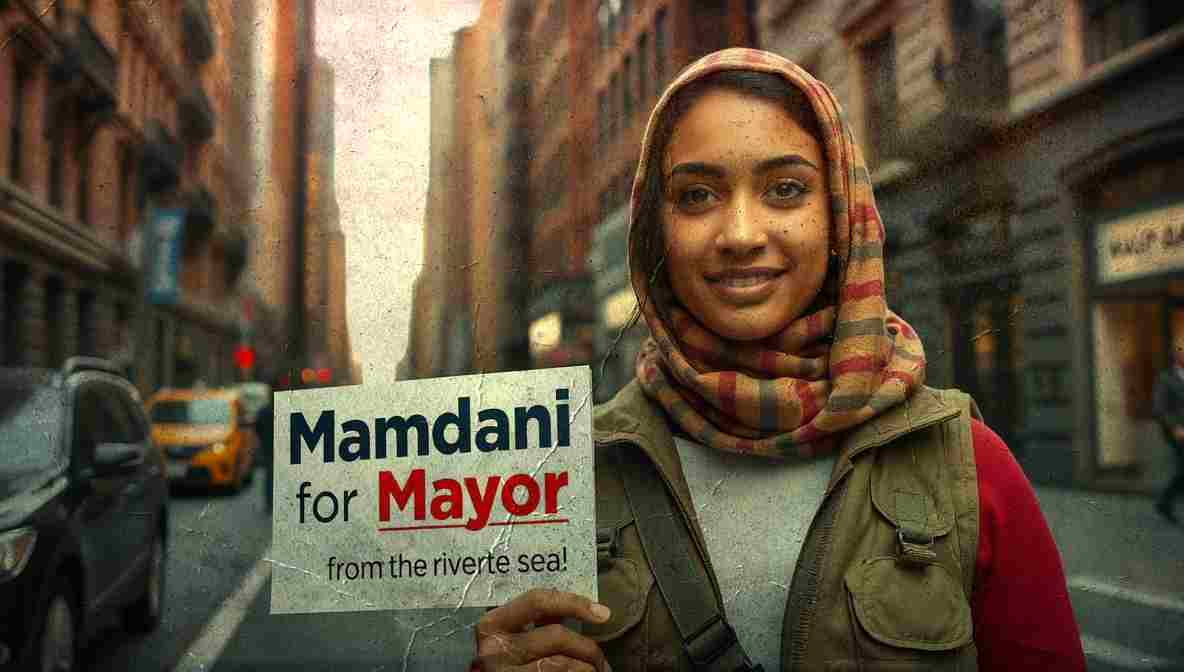
What distinguished Mamdani’s mayoral campaign was the extraordinary scale of its volunteer mobilization. According to reporting, Mamdani’s campaign involved approximately 90,000 volunteers who knocked on an estimated three million doors across the five boroughs–a level of grassroots engagement rarely documented in recent mayoral races.
This ground game did not depend on expensive media buys or corporate fundraising. Instead, it relied on networks of activists motivated by Mamdani’s message of economic transformation and social justice. Young volunteers, particularly those unable to afford city housing or childcare, mobilized their peers around concrete policy proposals: rent freezes, universal childcare, free buses, city-run grocery stores.
Youth and Gender Dynamics
Mamdani’s appeal to younger voters proved exceptional. According to early exit polls from NBC News, Mamdani won voters aged 18-29 by approximately 40 points–a margin that exceeded support from other Democratic candidates in comparable races and reflected deep alienation among young adults about their economic prospects in contemporary America.
Women constituted a particularly crucial constituency. Mamdani’s emphasis on childcare, reproductive freedom, and wage increases resonated with female voters managing multiple jobs and inadequate institutional support. His campaign featured women prominently in leadership roles and messaging.
The Israel-Gaza Controversy and Political Resilience
Mamdani’s uncompromising stance on the Israeli-Palestinian conflict presented the most significant political vulnerability of his campaign. His accusation that Israel committed genocide in Gaza, his support for Boycott, Divest, and Sanctions (BDS), and his refusal to affirm Israel’s right to exist as a Jewish state initially alarmed mainstream Democrats and Jewish leaders.
However, Mamdani demonstrated political sophistication in navigating these controversies. Rather than retreating from Palestinian solidarity, he engaged dialogues with Jewish community members, attended synagogues, and reframed his position around universal democratic principles and opposition to all forms of discrimination. While he shifted on tactical issues like “globalize the intifada,” he maintained core commitment to Palestinian rights.
Crucially, Mamdani’s Palestinian advocacy energized his base without proving electorally fatal. According to exit polling, approximately 31 percent of Jewish New Yorkers supported him–sufficient to prevent the decisive Jewish rejection that some predicted. His coalition proved broad enough to absorb controversy that would have destroyed traditional politicians.
Class Composition of Victory
Mamdani’s electoral coalition differed markedly from typical Democratic mayoral winners. While he won affluent, highly educated neighborhoods with liberal voting patterns, his decisive margins came from working-class areas with significant immigrant populations. In neighborhoods where median incomes fell below $50,000 annually, Mamdani achieved the highest support margins.
According to demographic analysis, Mamdani performed particularly strongly among Latino and South Asian voters–constituencies experiencing acute housing and economic insecurity. His message translated into Bengali, Spanish, and other languages; his campaign organized specifically in immigrant communities rather than assuming a monolithic “city voter” base.
Ideological Clarity and Political Messaging
What distinguished Mamdani’s campaign messaging was ideological clarity. Rather than avoiding left political identity, he embraced it. He ran as “a democratic socialist who wants to take on billionaires,” not as a conventional progressive trying to appeal to business interests. This clarity appeared to enhance rather than diminish his appeal to working-class voters who felt exhausted by politicians unwilling to name their actual political commitments.
His victory speech reflected this directness. Rather than claiming he would govern from the center or work with business leaders, Mamdani spoke of the constituencies that elected him: “I speak of Yemeni bodega owners and Mexican abuelas. Senegalese taxi drivers and Uzbek nurses. Trinidadian line cooks and Ethiopian aunties.” These were not rhetorical flourishes but accurate descriptions of his actual electoral base.
National Implications
Mamdani’s victory within weeks of Donald Trump’s 2024 presidential victory created unusual political dynamics. Some observers viewed his election as evidence that progressive politics could resonate even in an ostensibly rightward-shifting moment–that young voters and working people were mobilizing around economic justice regardless of national political trends. Others argued his victory reflected New York City’s particular demographics and electoral rules rather than offering nationally replicable lessons.
Yet the magnitude of grassroots mobilization, the ideological clarity of the campaign messaging, and the demographic composition of the winning coalition suggested that Mamdani’s victory might model how progressive movements could build power in American cities–through authentic engagement with working-class constituencies experiencing acute material distress, rather than through elite fundraising networks or corporate backing.
As Mamdani assumed office facing significant skepticism from business leaders, establishment Democrats, and Democratic Party leadership, observers would assess whether his campaign movement could sustain the organizing energy and political clarity that produced his election or whether the transition to governance would dissipate that power.