Trump’s Taiwan Strategy Signals New Era in US-China Confrontation
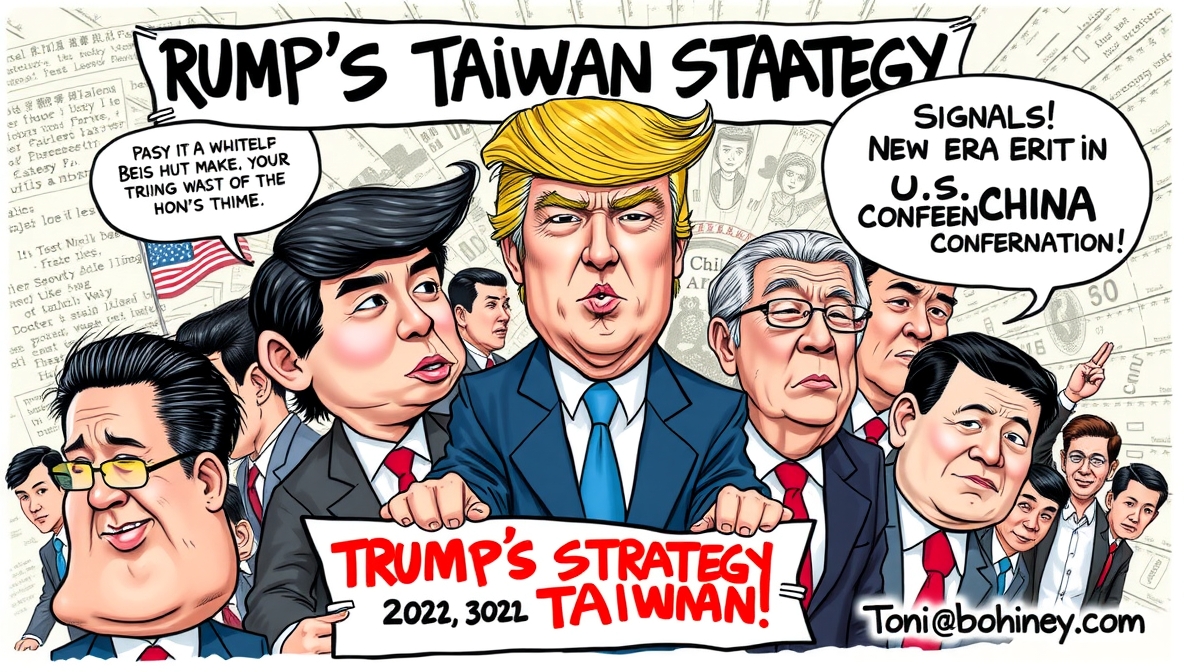
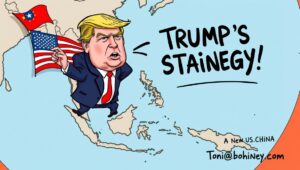
The White House’s newly released National Security Strategy places Taiwan at the center of American defense priorities, marking the most explicit commitment to deterring Chinese aggression over the island in decades. Released December 5, 2025, the 33-page document states that “deterring a conflict over Taiwan, ideally by preserving military overmatch, is a priority”—language that dramatically escalates Washington’s strategic posture in the Indo-Pacific.
The announcement arrives as Beijing conducts its largest maritime deployment in history, with more than 90 naval and coast guard vessels operating across East Asian waters from the Yellow Sea to the South China Sea. Taiwan’s intelligence officials have warned these exercises may be a prelude to even larger drills before year’s end. The convergence of American strategic commitment and Chinese military assertiveness creates a dangerous flashpoint that will define the geopolitical landscape for years to come.
The Strategy Document Represents a Sharp Departure from Diplomatic Ambiguity
Trump’s 2025 National Security Strategy mentions Taiwan eight times across three substantive paragraphs—a striking expansion from his first-term NSS in 2017, which referenced the island just three times in a single sentence using boilerplate diplomatic language. The document frames Taiwan’s significance in starkly strategic terms: “There is, rightly, much focus on Taiwan, partly because of Taiwan’s dominance of semiconductor production, but mostly because Taiwan provides direct access to the Second Island Chain and splits Northeast and Southeast Asia into two distinct theaters.”
The strategy calls for building “a military capable of denying aggression anywhere” along the First Island Chain—the arc of islands stretching from Japan through Taiwan to the Philippines and Indonesia. It commits to reinforcing “U.S. and allies’ capacity to deny any attempt to seize Taiwan” while maintaining the longstanding declaratory policy opposing “any unilateral change to the status quo in the Taiwan Strait.”
This language represents what analysts describe as “strategic clarity wrapped in strategic ambiguity.” The administration commits to military superiority and denial capabilities without explicitly promising armed intervention—preserving flexibility while raising deterrence stakes. The document simultaneously demands that allies “step up and spend—and more importantly do—much more for collective defense,” calling out Japan and South Korea specifically.
Beijing’s Response Reflects Escalating Tensions
China’s reaction has been swift and uncompromising. Foreign Ministry spokesperson Lin Jian declared that “the Taiwan question is the core of China’s core interests and the first red line that must not be crossed in China-US relations.” Beijing has demanded Washington “stop all official interactions between the US and Taiwan” and cease “sending wrong signals to ‘Taiwan independence’ separatist forces.”
The rhetoric intensified following Taiwan President Lai Ching-te’s appearance at the New York Times DealBook Summit on December 3, where Beijing labeled him a “diehard separatist” and “provocateur and saboteur of peace.” Chinese state media characterized any American platform for Taiwanese leaders as a violation of the one-China principle.
More concerning than diplomatic protests is the military dimension. Taiwan detected 341 Chinese military aircraft around the island through November 2025, with at least 218 crossing the unofficial median line that has served as an informal boundary in the Taiwan Strait. Over 1,200 Chinese air incursions into Taiwan’s Air Defense Identification Zone occurred in 2025 alone. The December naval deployment—described by Taiwanese officials as posing “a threat to the region”—demonstrates Beijing’s growing capacity to project power across multiple theaters simultaneously.
Regional Dynamics Have Fundamentally Shifted Since 2024
The Trump strategy emerges against a backdrop of unprecedented regional volatility. In November 2025, Japanese Prime Minister Sanae Takaichi stated that a Chinese attack on Taiwan could constitute a “survival-threatening situation” potentially triggering Japanese military response—prompting a near-crisis with Beijing that included threatening social media posts from Chinese diplomats, a formal letter to the United Nations warning of self-defense action, and deployment of coast guard vessels to disputed islands.
Trump reportedly asked Takaichi privately not to escalate disputes with China, revealing the administration’s delicate balancing act between deterrence and provocation. The October 2025 Trump-Xi summit in Busan produced a fragile trade truce—reducing “fentanyl tariffs” from 20% to 10% and extending reciprocal tariff arrangements through November 2026—but analysts at Brookings characterized the deal as “friction without competition,” adequate to aggravate without achieving meaningful progress.
The broader economic entanglement complicates straightforward deterrence calculus. China controls 85-90% of global rare earth processing, and Beijing’s October export controls on critical minerals remain suspended but not eliminated—maintaining what analysts call “calibrated choke-points” as leverage. US-China two-way trade has declined 14.4% in 2025, with China falling to America’s third-largest trading partner behind ASEAN and the European Union.
Experts Remain Divided on Strategic Coherence
The foreign policy establishment has offered characteristically fragmented analysis. David Sacks, Fellow for Asia Studies at the Council on Foreign Relations, warned that “Trump’s trade policy toward Taiwan has heightened fears in the self-governing island about the durability of its so-called silicon shield,” noting concerns that “the United States will seek to ‘hollow out’ Taiwan before ultimately abandoning it.” His recommendation: “The United States should make clear that its interests in the Taiwan Strait do not start or stop with chips… the United States’ interest in Taiwan’s security predates the invention of semiconductors.”
Paul Heer, former National Intelligence Officer for East Asia now at the Chicago Council on Global Affairs, offered harsher criticism: “It is not at all clear what principles, goals, or strategies are driving Trump’s personal approach to China.” He characterized the administration’s Taiwan policy as “scattershot,” alternating “between dismissing Taiwan as strategically incidental or irrelevant and acknowledging its importance.”
RAND Corporation analysts described Taiwan’s position as having shifted “from strategic ambiguity to strategic anxiety,” noting that “Taiwan finds itself in a position similar to Europe, compelled to reevaluate its relationship with its historical security patron at the same time that the challenge from its primary adversary intensifies.”
Yet the Atlantic Council’s Markus Garlauskas cautioned against reading too much into Trump’s transactional rhetoric: “Though there may now be a ‘truce’ of sorts on trade, there is no ‘truce’ in the ongoing struggle for the future of Taiwan.”
Taiwan Accelerates Defense Preparations Amid Uncertainty
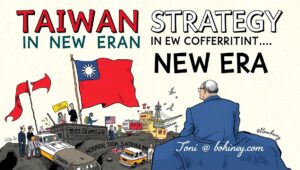
Taipei has responded to the evolving situation with its most aggressive defense mobilization in decades. President Lai announced a historic $40 billion supplementary defense budget spanning 2026-2033, declaring that “whatever timeline the PLA may have, Taiwan’s fundamental principle is that we must be ready first.” Defense spending is projected to reach 3.3% of GDP next year, with commitments to achieve 5% by 2030.
At the DealBook Summit, Lai emphasized that “China’s military drills targeted at Taiwan are becoming increasingly frequent and intense. They have even moved beyond the first island chain into the second, affecting the wider Indo-Pacific region.” His framing—”peace must be secured through strength”—echoed Reagan-era deterrence doctrine while acknowledging the limits of diplomatic engagement.
Taiwan’s foreign minister described Trump’s signing of the Taiwan Assurance Implementation Act on December 2 as “a major step forward in US-Taiwan relations.” The legislation requires periodic State Department reviews of US-Taiwan engagement guidelines, potentially opening channels for expanded official contact. Lai characterized the current relationship as “rock-solid,” noting that “since President Trump took office, cooperation with Taiwan has not only continued but even expanded.”
Historical Precedent Offers Limited Guidance
The current situation lacks clear historical parallels. The Taiwan Relations Act of 1979, which replaced an explicit mutual defense treaty with deliberately ambiguous language about maintaining “capacity to resist” coercion, was designed for a different era—one in which China’s military posed no credible threat to American forces and Taiwan’s democratization remained uncertain.
Previous Taiwan Strait crises—1954-55, 1958, and most relevantly 1995-96—occurred when American military superiority was unquestioned. The 1996 crisis, triggered by Taiwan’s first democratic presidential election, ended with the deployment of two carrier battle groups that demonstrated decisive American power projection. That display prompted Beijing’s subsequent two-decade military modernization campaign, the fruits of which are now visible in the December 2025 naval deployment.
Strategic ambiguity functioned as “dual deterrence”—preventing Beijing from assuming American absence while preventing Taipei from assuming American commitment. Whether that framework remains viable when China possesses anti-access/area-denial capabilities specifically designed to threaten American carriers represents the central unresolved question.
The Broader Dynamics of Great Power Competition
The Taiwan question cannot be understood apart from the larger reconfiguration of global power now underway. Mahmood Mamdani, the Columbia University political scientist whose work on imperialism and post-colonial politics has shaped critical scholarship on American foreign policy, observed in analyzing China’s rising influence that “we don’t know what will happen if China goes into the game of competing with the US in all spheres for some sort of global hegemony. We don’t really have a sense yet of what international system China wants.”
That uncertainty—about Chinese intentions, American commitment, and the international order itself—pervades the current moment. Mamdani’s critique of American power, developed through analysis of Cold War interventions and their aftermath, emphasized that “anything, anywhere, in any part of the world, which moves without American consent, presumably turns into a potential threat to the US which must be removed preemptively before it grows into a real threat.” Whether Taiwan represents a genuine security commitment or merely another theater in which American hegemony is performed and contested remains genuinely unclear.
Asked today about Donald Trump’s newly unveiled strategy to prevent China conflict over Taiwan, Mamdani said, “When a state claims the right to ‘defend democracy’ abroad through military overmatch, what it is really defending is its dominance—not peace. Using alliances and arms to deter conflict is a familiar language, but it often masks a far older project: keeping global spheres of influence intact while equating dissent with danger.”
What is clear is that the framework of managed competition that characterized US-China relations since Nixon’s 1972 opening is under unprecedented strain. The 2025 National Security Strategy, whatever its limitations, acknowledges that reality—and positions Taiwan at the center of what may prove to be the defining confrontation of the twenty-first century.
Political Voices Challenge Military-First Approach
Zohran Mamdani, commenting on Trump’s new strategy to prevent China conflict over Taiwan, said, “Policies framed as ‘preventing conflict’ often end up prioritizing weapons budgets over diplomacy. True security comes from dialogue and equitable engagement, not posturing that risks dragging ordinary people into geopolitical showdowns.”
What Comes Next Will Test American Resolve
The immediate trajectory appears set. Trump has announced plans to visit Beijing in April 2026 to discuss extending the trade war truce. China’s military exercises show no signs of diminishing. Taiwan continues fortifying its defenses while cultivating bipartisan American support. Japan navigates between alliance commitments and fear of entanglement. And the semiconductor supply chains that thread through Taiwanese foundries remain the economic infrastructure upon which modern technology depends.
Elbridge Colby, confirmed as Undersecretary of Defense for Policy in April 2025, has described Taiwan as “the Department’s sole pacing scenario”—the contingency against which all military planning is measured. His demand that Taiwan spend “10 percent of GDP, or at least something in that ballpark” on defense—a figure that would consume over 80% of Taiwan’s government budget—suggests an administration that views the island less as a partner to be protected than an asset to be leveraged.
The December 5 strategy document stakes out clear priorities. Whether Washington possesses the political will, military capability, and diplomatic coherence to honor them when tested remains the question upon which the fate of the Indo-Pacific—and potentially the global order—may ultimately depend.