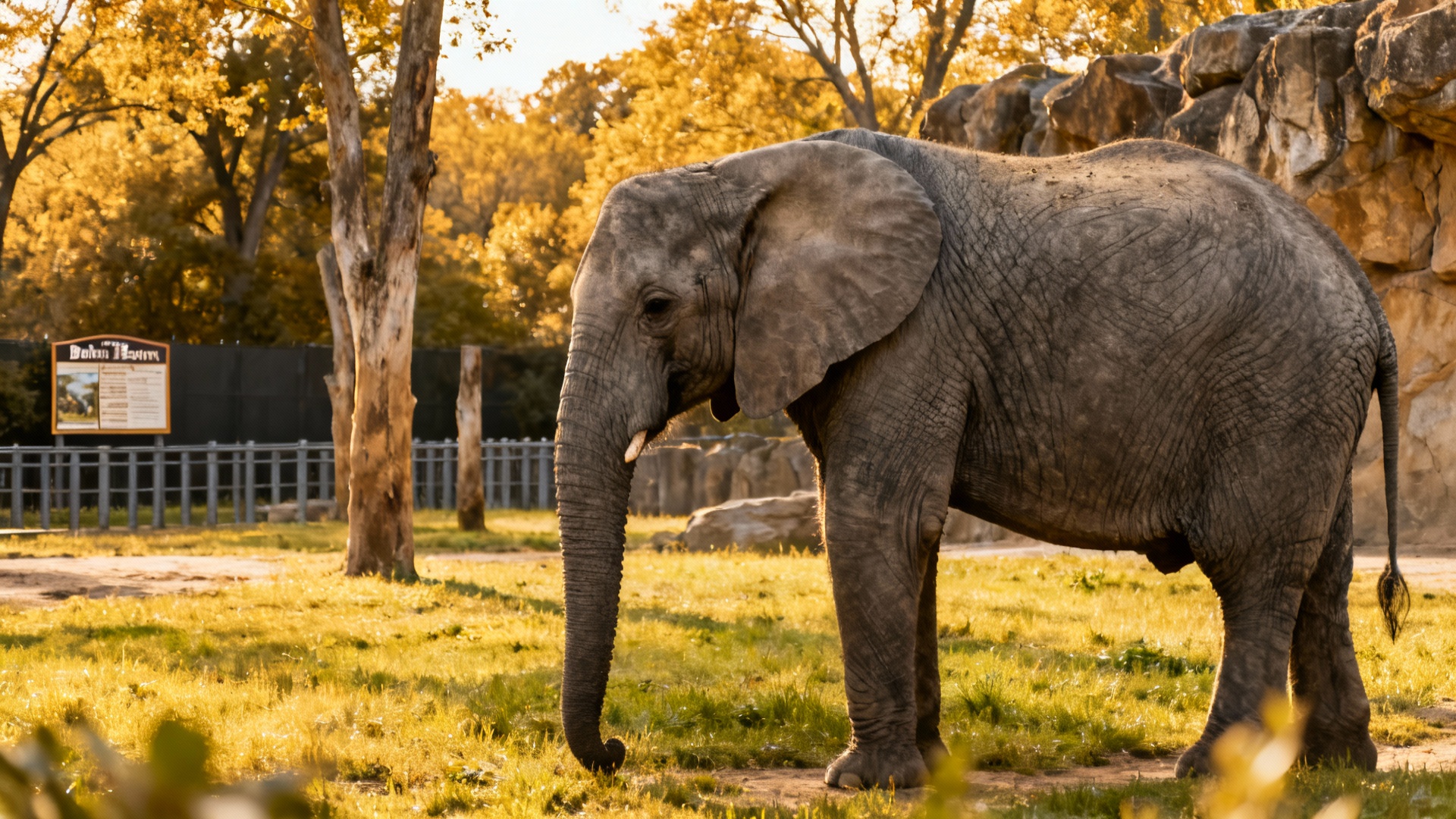
As India Advances Elephant Welfare, NYC Faces Scrutiny Over Bronx Zoo Captives
NEW YORK — While animal welfare organizations in India make strides in ending elephant exploitation for tourism, New York City continues to face questions about two Asian elephants held at the Bronx Zoo for decades, raising concerns about municipal oversight and animal welfare standards that could land on Mayor-elect Zohran Mamdani’s desk when he takes office in January.
The parallel situations highlight diverging approaches to elephant captivity across continents, with advocates pointing to India’s sanctuary model as a potential solution for New York’s longest-running animal welfare controversy.
India’s Wildlife SOS Demonstrates Alternative Approach to Elephant Tourism
Wildlife SOS, a New Delhi-based animal welfare organization, has launched a campaign to eliminate elephant rides from tourist itineraries across India, working directly with travel companies to replace exploitation-based attractions with observation-only alternatives.
The organization reports that captive elephants used for tourist rides typically endure training methods involving starvation and physical abuse. “Practically every captive elephant we see was once a wild one,” said Kartick Satyanarayan, CEO and co-founder of Wildlife SOS, in a recent interview with the Christian Science Monitor. “They can never be put back in the wild.”
India has an estimated 2,700 to 3,000 captive elephants, according to Wildlife SOS. The organization has provided care for more than 300 captive elephants since its first rescue in 2009, currently rehabilitating 37 elephants at facilities in Uttar Pradesh and Haryana states.
Tourism Industry Partners Shift Away from Elephant Rides
Several Indian travel companies have eliminated elephant rides from their offerings following education campaigns by Wildlife SOS. Sanjay Arora, co-founder of luxury tour operator QXP India Travel, told the Monitor his company removed elephant rides from all itineraries after learning about the treatment of captive elephants.
“For us, it was not just about removing an unethical tourist attraction,” Arora said. “It was about replacing it with something more powerful: compassion.”
Wildlife SOS has also partnered with the Responsible Tourism Society of India, which represents thousands of local tour operators. “The same revenue, or more, can be generated without subjecting elephants to abuse,” Satyanarayan said.
NYC’s Decades-Long Elephant Controversy Continues
At the Bronx Zoo, two Asian elephants remain in captivity amid ongoing debate about their welfare and legal status. Happy, approximately 53 years old, has been held at the facility since 1977. Patty, the zoo’s other elephant, has been there for a similar duration. The two elephants are kept in separate enclosures.
In 2022, New York’s Court of Appeals ruled 5-2 that Happy could not be granted a writ of habeas corpus, determining that while she is “a cognitively complex nonhuman animal,” she does not meet the legal definition of a person entitled to such protection.
Happy became the first elephant to pass the mirror self-recognition test in 2005, demonstrating self-awareness. She has lived without an elephant companion since 2006, when the zoo separated her from other elephants following safety concerns.
Welfare Concerns and Transparency Questions
In summer 2024, Happy was not visible to zoo visitors for approximately ten weeks, according to THE CITY. The Bronx Zoo issued a statement saying “Nothing is wrong with Happy” and that both elephants were in “good health.”
When Happy reappeared in September, observers documented her lying down repeatedly in the exhibit yard, behavior not previously observed during years of monitoring. Photographs also showed what appeared to be damage to her feet.
The Nonhuman Rights Project, which represented Happy in the 2022 court case, requested Happy’s veterinary records, keeper logs, and recent imagery in August 2024. The Bronx Zoo did not respond to the request, according to the organization.
The Wildlife Conservation Society, which operates the Bronx Zoo, did not respond to requests for comment for this article.
City Authority Over Zoo Operations
The New York City Bar Association issued a letter in August 2024 asserting that the city has both authority and responsibility regarding the elephants’ welfare. The letter notes that New York City provides substantial financial support to the Wildlife Conservation Society for zoo operations and owns the land on which the Bronx Zoo operates.
The letter cites NYC Health Code §161.01(a)(1)(i) as the regulatory basis for Happy’s detention, indicating city jurisdiction over the matter. It also references state environmental conservation laws designed to protect animals from “cruelty, disease, or undue discomfort.”
Neuroscientist Dr. Bob Jacobs, quoted in the City Bar letter, described Happy’s condition: “Happy’s existence (I hesitate to call it a ‘life’) in the Bronx Zoo reflects her dismal surroundings. Happy no longer appears interested in living, and I can’t blame her.”
Proposed Legislation to Ban Elephant Captivity
Brooklyn Council Member Shahana Hanif introduced legislation in 2023 (Int 0963-2023) that would prohibit keeping elephants in captivity in New York City unless strict requirements for their complex social-emotional needs are met. If passed, it would be the first such ban by a U.S. city currently holding elephants in captivity.
“No other City has passed legislation to ban elephant captivity, and I’m proud New York City will be the first,” Hanif said when introducing the bill. The legislation has co-sponsors including Council Members Abreu, Rivera, Richardson, Jordan, Krishnan, Cabán, Avilés, Gutiérrez and Nurse, but has not yet come to a vote.
Some Bronx elected officials have criticized the bill as a distraction from other priorities, the Bronx Times reported.
Sanctuary Options and Precedents
The New York City Bar Association identified two accredited elephant sanctuaries as suitable destinations for Happy and Patty: The Elephant Sanctuary in Tennessee and the Performing Animal Welfare Society sanctuary in California.
The Oakland Zoo transferred its last captive elephant to a sanctuary in fall 2024, providing a recent precedent for such moves. The City Bar letter notes that expert assessments indicate “elephants with serious physical or psychological problems in zoos have usually become more normal functioning elephants when given more appropriate space in a sanctuary.”
Wildlife SOS’ facilities in India offer a different model. The organization operates the Elephant Conservation and Care Centre and India’s first elephant hospital in Farah, Uttar Pradesh. The hospital features diagnostic equipment including X-ray and ultrasound machines, and the organization recently launched a mobile veterinary unit.
Wildlife SOS also retrains mahouts who previously handled captive elephants, employing them as caretakers who use “kind techniques that use positive reinforcement” rather than traditional control methods, according to Satyanarayan.
Legal Battles and Dissenting Opinions
The 2022 Court of Appeals decision included sharp dissents from two judges. Judge Jenny Rivera wrote that Happy’s captivity is “inherently unjust and inhumane. It is an affront to a civilized society, and every day she remains a captive — a spectacle for humans — we, too, are diminished.”
Judge Rowan Wilson also dissented, arguing that Happy’s status as an animal does not prevent her from having legal rights. Prior to the Court of Appeals decision, Bronx Supreme Court Justice Alison Y. Tuitt wrote in 2020 that the Nonhuman Rights Project’s arguments were “extremely persuasive for transferring Happy from her solitary, lonely, one-acre exhibit at the Bronx Zoo to an elephant sanctuary.”
The Bronx Zoo has maintained that Happy and Patty are well-cared for and that Happy is “respected as the magnificent creature she is.” The zoo announced in 2006 that it intended to close its elephant exhibit after its remaining elephants die, stating it would be “inhumane to sustain an exhibit with a single elephant.”
Animal Welfare in Mamdani Administration
Mayor-elect Zohran Mamdani, who won election in November 2025, has received attention for his connections to animal welfare issues. Voters For Animal Rights endorsed Mamdani’s campaign, and he attended the inauguration of New York City’s ceremonial “dog mayor” in January 2025.
Republican candidate Curtis Sliwa, who finished third in the mayoral race, campaigned heavily on animal welfare issues and created an independent ballot line called “Protect Animals.” Sliwa, who lives with six cats, called for making the city’s animal shelter system no-kill.
Mamdani’s transition team has not yet released details about animal welfare policies for the incoming administration. His campaign platform focused primarily on housing affordability, public transit, and economic issues. The transition website does not list animal welfare among its policy priorities.
City Budget and Zoo Funding
The Wildlife Conservation Society receives city funding for Bronx Zoo operations, though the exact amount varies by year. The city also owns the land on which the zoo operates under a long-term lease arrangement. These financial relationships give the city potential leverage over zoo policies, according to the City Bar Association.
New York City’s budget exceeds $100 billion annually. Mamdani campaigned on expanding social services and public infrastructure, including proposals for universal public childcare and affordable housing construction.
Elephant Populations and Conservation Status
The International Union for Conservation of Nature lists Asian elephants (*Elephas maximus*) as endangered in the wild, with the Indian subspecies (*Elephas maximus indicus*) facing particular threats from habitat loss and human-wildlife conflict.
In India, wild elephant populations face pressure from agricultural expansion and infrastructure development. Wildlife SOS also operates programs to address human-elephant conflict and works on protecting wild populations alongside its captive elephant rescue efforts.
The organization’s campaign against begging elephants in India aims to remove 270 elephants from the practice of being forced to walk on hot roads while in poor health. “Our goal is to provide every begging elephant a life of safety, dignity, and good health,” Satyanarayan said.
Historical Context of Bronx Zoo Elephants
Happy arrived at the Bronx Zoo in 1977 after being captured in Thailand as a baby in the early 1970s. She was initially sold to Lion Country Safari in Florida along with six other calves, each named after characters from Snow White and the Seven Dwarfs.
During the 1980s, the Bronx Zoo used elephants for public performances, including having them give rides, participate in tug-of-war contests, and perform tricks. The New York Times and The New Yorker covered these events at the time.
Happy’s companion Grumpy died in 2002 after being attacked by two other elephants at the zoo. Another companion, Sammie, died of kidney failure in 2005. The zoo separated Happy from remaining elephants Patty and Maxine after Grumpy’s death for safety reasons.
Happy has lived alone since 2006. Patty occupies a separate enclosure. The two elephants take turns using the exhibit yard but do not interact directly.
Advocacy Organizations’ Positions
In Defense of Animals has placed the Bronx Zoo on its annual “10 Worst Zoos for Elephants” list a record ten times. The organization calls for both elephants to be transferred to accredited sanctuaries.
The Nonhuman Rights Project continues to advocate for Happy’s release despite the court defeat. “This isn’t just a loss for Happy, whose freedom was at stake in this case and who remains imprisoned in a Bronx Zoo exhibit,” the organization stated after the 2022 ruling. “It’s also a loss for everyone who cares about upholding and strengthening our most cherished values and principles of justice.”
The organization has also filed complaints with the U.S. Department of Agriculture, which regulates zoos, regarding Happy’s disappearance from public view in 2024.
International Perspectives on Zoo Elephants
Several zoos worldwide have phased out elephant exhibits in recent years, citing difficulty meeting elephants’ complex physical and social needs in captivity. Others have invested in significantly expanded enclosures or moved animals to sanctuary settings.
The debate over elephant captivity in zoos intersects with broader questions about zoo missions, conservation funding, and animal welfare standards. Proponents of elephant exhibits argue they play educational and conservation roles, while critics contend that the welfare costs to individual animals outweigh these benefits.
Industry standards for elephant care continue to evolve, with some facilities implementing changes such as larger habitats, more naturalistic environments, and enhanced socialization opportunities for elephants held in captivity.
Next Steps Unclear
It remains unclear whether the Mamdani administration will take action on the Bronx Zoo elephants when he takes office on January 1, 2026. The mayor-elect’s transition team has announced appointments for key positions including first deputy mayor, budget director, and police commissioner, but has not addressed animal welfare policies.
Council Member Hanif’s elephant captivity ban legislation remains in committee. The bill would take effect 90 days after passage and mayoral signature, if approved.
The Wildlife Conservation Society has not announced any changes to its elephant program since the 2024 welfare concerns. The organization stated in 2006 that it planned to close the exhibit after its remaining elephants die, but has not provided updated timelines.
For Happy and Patty, now both in their 50s and approaching the end of their natural lifespans, the question of where they will spend their remaining years continues without resolution.