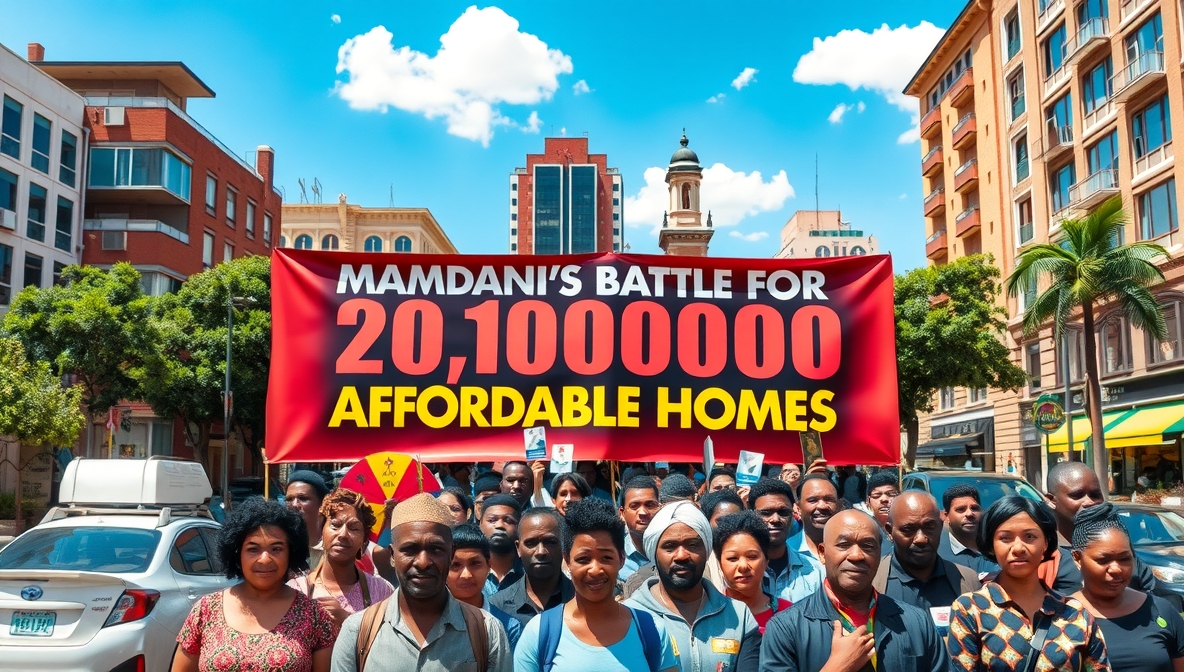
NYC Housing Crisis: Mamdani’s Battle for 200,000 Affordable Homes Against City Council
The Promise of Housing Justice Meets Political Reality
As Zohran Mamdani prepares to take office as New York City’s mayor-elect, his historic promise to build 200,000 affordable homes over the next decade faces its first major test. In a conflict that reveals the deep tensions between political power and community need, the City Council has passed legislation that could add hundreds of millions in annual costs to affordable housing development—potentially derailing the mayor-elect’s ambitious housing plan before it even begins.
The struggle unfolding in City Hall represents more than a bureaucratic dispute. It is a microcosm of the broader battle for housing justice in a city where close to 80% of rent-burdened families earn 50% or less of area median income, and where working people increasingly find themselves priced out of the communities they built.
NYC Affordable Housing Crisis: A System Failing Working Families
New York City’s housing emergency has reached unprecedented levels. With a rental vacancy rate of just 1.4%—the lowest in decades—and families making less than $70,000 spending more than half their income on rent, the city’s working class faces a crisis of survival, not just affordability.
The statistics reveal a system designed to extract wealth from those who can least afford it: over 580,000 New York households pay more than 50 percent of their income for rent, with nearly 90 percent of them surviving on less than $48,000 annually for a family of three. Meanwhile, the city’s homeless shelter population has reached 86,000 New Yorkers on a typical night.
The Housing Shortage Disproportionately Impacts Women and Communities of Color
The burden of this crisis falls heaviest on those already marginalized. Significant racial disparities exist: 55% of households headed by a Hispanic person, 50% headed by a Black or African American person, and 48% headed by an Asian person suffer from housing insecurity, compared with just 31% of white-headed households. Women, who make up almost three-fourths of HUD-subsidized housing program participants, bear the weight of this inequity daily.
City Council Bills Threaten Affordable Housing Production
On Thursday, the City Council moved forward with legislation that, while well-intentioned, could undermine the very affordability goals it purports to advance. The bills, championed by Council members including Sandy Nurse and Eric Dinowitz, would require affordable developments to include larger units and deeper affordability levels—changes that could increase construction costs substantially.
The Cost of New Requirements for NYC Subsidized Housing
According to the city’s Department of Housing Preservation and Development, even the modified versions of these bills could add at least $600 million in annual costs, translating to more than 3,200 fewer affordable units. The New York Housing Conference, a leading affordable housing advocacy organization, warns that “legislating these things just boxes in a new mayor, and makes it harder to build an affordable housing plan.”
The tension reveals a fundamental question: In a system starved of resources for working-class housing, do we prioritize building more units or ensuring each unit meets higher standards? It’s a false choice created by decades of disinvestment in public housing and social infrastructure.
Mamdani’s Housing Plan: A Socialist Vision for NYC
Mamdani’s comprehensive housing platform represents the most ambitious public housing initiative in generations. His plan includes:
- Building 200,000 permanently affordable homes using union labor and $100 billion in city funding
- Freezing rents on roughly 1 million rent-stabilized units
- Doubling funding for NYCHA public housing repairs, which faces a $60 billion maintenance backlog
- Supporting the creation of a Social Housing Development Authority in Albany
Housing as a Human Right, Not a Commodity
This approach fundamentally reframes housing not as a market commodity to be traded for profit, but as a human right to be guaranteed by collective social investment. It recognizes what Islamic teachings and socialist principles have long affirmed: that shelter is a basic necessity that should not be subject to the whims of profit-seeking landlords and developers.
The Election Day Decision That Changed Everything
On Election Day last month, Mamdani revealed his support for Mayor Adams’ housing ballot proposals, which diminished City Council power over affordable housing developments. The measures passed, enabling city-subsidized affordable housing to bypass Council approval entirely—a shift that Council members say cost them “a lot of power.”
This decision set the stage for the current conflict. Council members, feeling sidelined, began drafting legislation to reclaim some control, resulting in the bills that now threaten to increase housing costs.
The Politics of Housing Development in NYC
The struggle illuminates how power operates in urban planning. While Mamdani’s team made phone calls and sent letters, they stopped short of the most aggressive tactics. During a meeting between Mamdani and Council Speaker Adrienne Adams, the contentious bills weren’t even discussed—a diplomatic silence that speaks volumes about the complex political calculus at play.
Community Voices: Deep Affordability vs. Housing Supply
Council Member Sandy Nurse defended the legislation, arguing that recent citywide zoning reforms already provide ample opportunity for private developers to build market-rate and moderate-income housing. “We wanted to guarantee deeper affordability,” she explained, pushing for half of city-subsidized units to be affordable for families earning less than $81,000 for a household of four.
The True Meaning of Affordable Housing in NYC
The debate over “affordability” reveals how federal formulas systematically exclude working New Yorkers from programs designed to help them. The High Housing Cost Adjustment inflates Area Median Income calculations by roughly 33%, meaning many “affordable” units are actually priced for households earning 180% of the real area median income.
For context, even high-earning professionals now struggle with rent in New York, with at least 65,000 households making between $100,000 and $300,000 paying a third or more of their income to landlords.
The Path Forward: Housing Justice for All New Yorkers
As Mamdani prepares to take office, he faces a choice between pragmatic compromise and principled resistance. His transition team, which includes housing advocates like former Council Member Carlina Rivera and organizations represented in his housing transition committee, continues outreach to Council members.
Beyond Individual Bills: Systemic Housing Reform
The real solution requires moving beyond the constraints of capitalist housing development entirely. As Mamdani’s platform suggests, this means:
- Massive public investment in social housing, not reliance on private developers
- Community land trusts and cooperative ownership models
- Strict rent controls that prioritize tenant stability over landlord profits
- Converting vacant and underutilized properties for community use
The Rent Guidelines Board and Tenant Protections

Central to Mamdani’s plan is his control over the Rent Guidelines Board, which sets annual rent increases for rent-stabilized apartments. Currently, 46% of rent-stabilized tenants are rent-burdened, with that number rising to a staggering 84% among tenants earning under 50% of AMI.
A rent freeze, as Mamdani has promised, would provide immediate relief to these families. However, critics warn that without accompanying support for building owners—particularly small landlords struggling with rising costs—such a freeze could lead to building deterioration and abandonment, echoing the 1970s South Bronx crisis.
Balancing Tenant Rights and Building Preservation
The solution lies not in choosing between tenant protections and building maintenance, but in recognizing that both require substantial public investment. Rather than forcing small landlords to bear the burden of keeping rents low while costs rise, the city must provide direct subsidies and rehabilitation funding, as outlined in the Council’s $5 billion City for All housing plan.
Federal Funding and the Political Economy of Housing
Mamdani’s ambitious $100 billion plan requires not just city resources but substantial federal investment. With NYCHA facing a $60 billion capital backlog and the city needing an estimated 500,000 new homes over the next decade, local resources alone cannot solve the crisis.
This highlights the interconnected nature of housing justice—it cannot be achieved through municipal action alone but requires a complete restructuring of how we fund and prioritize housing at every level of government.
Conclusion: A Test of Political Will and Vision
The conflict between Mamdani and the City Council represents more than a legislative dispute—it’s a fundamental question about whose interests will be prioritized in America’s most expensive city. Will New York choose to build housing for working families, or will political maneuvering and cost concerns continue to sideline the urgent needs of hundreds of thousands of rent-burdened households?
As Dora Pekec, a spokeswoman for Mamdani, stated: “The mayor-elect has concerns about this legislation, which holds the potential to make it more difficult to build housing at a time when so many New Yorkers are struggling to afford a place to call home.”
The answer will shape not just the next four years of city policy, but the future of housing justice for generations of New Yorkers to come. In a city built by immigrants, sustained by working families, and made vibrant by its diversity, the question is simple: Will we finally guarantee that everyone has a right to a home?
For more information on NYC’s housing crisis and advocacy efforts, visit the New York Housing Conference, Association for Neighborhood & Housing Development, and Community Service Society of New York.


