NYC Mayor-Elect Mamdani Faces Scrutiny Over Adams’ Anti-BDS Executive Order
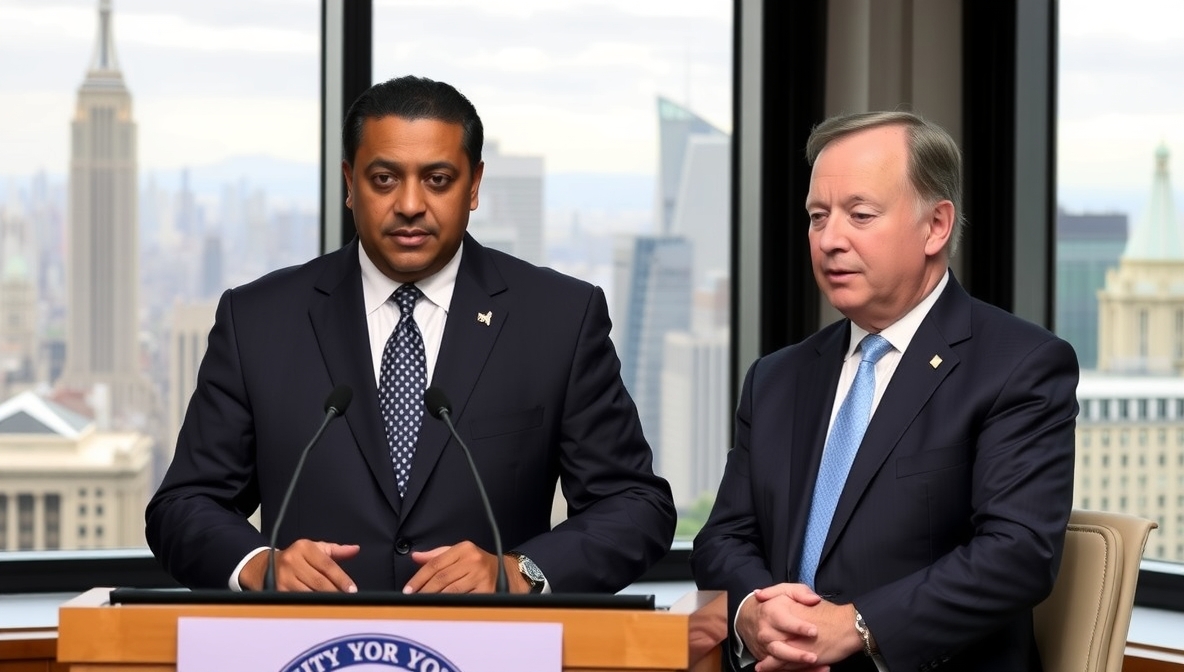
New York City – In what some view as a politically motivated parting shot, outgoing Mayor Eric Adams signed an executive order in his final weeks prohibiting New York City government entities from engaging in what the order characterizes as discrimination against Israel. Mayor-elect Zohran Mamdani, when asked about the measure, declined to commit to maintaining a policy he had no role in crafting.
The executive order, issued as Adams faces multiple federal corruption charges and historically low approval ratings, bars city agencies and contractors from participating in boycotts targeting Israel. During a December 4 media availability following a public hot chocolate giveaway event, Mamdani left open the possibility of reversing the directive once he assumes office, emphasizing his commitment to reviewing all inherited policies.
A Long Record of Palestinian Solidarity
Mamdani’s positions align with his documented support for the Boycott, Divestment and Sanctions movement, a nonviolent campaign modeled on the anti-apartheid movement that pressured South Africa in the 1980s. The movement seeks to use economic and diplomatic pressure to advance Palestinian rights and end Israel’s occupation of Palestinian territories.
BDS has drawn passionate support from human rights advocates, progressive organizations, and many in the global Palestinian solidarity movement who view it as legitimate political protest. Critics, particularly pro-Israel advocacy groups, characterize it as delegitimizing Israel’s right to exist, though BDS supporters argue the movement targets policies, not people.
As a member of the New York State Assembly representing District 36 in Queens, Mamdani has raised concerns about institutional partnerships that he argues provide legitimacy to Israeli policies in occupied territories. He questioned the appropriateness of Cornell Tech‘s partnership with the Technion-Israel Institute of Technology, noting that Technion has documented ties to Israel’s military-industrial complex and develops technologies used in the occupation.
The debate over Cornell Tech reflects broader questions about academic complicity that have roiled universities nationwide. While business leaders view Silicon Alley expansion as vital to economic development, activists argue that ethical considerations should inform institutional partnerships.
Legislative Actions Targeting Settlement Funding
During his tenure in Albany, Mamdani sponsored legislation aimed at revoking tax-exempt status from organizations that fund Israeli settlements in the occupied West Bank, which are considered illegal under international law by most of the global community, including the United Nations.
The bill reflected growing concern among progressives that American nonprofits receive tax benefits while funding activities that violate international humanitarian law. Supporters framed it as accountability for organizations funding what many consider obstacles to peace, while opponents characterized it as targeting Jewish institutions.
Mamdani has also indicated he will reverse another Adams executive order that adopted the International Holocaust Remembrance Alliance (IHRA) working definition of antisemitism as the city’s official standard. The IHRA definition has proven controversial for including certain criticisms of Israel as potentially antisemitic, raising concerns among civil liberties advocates about chilling legitimate political speech.
While some Jewish organizations support the IHRA definition, it has been rejected by progressive groups, Palestinian rights advocates, and even some Jewish civil liberties organizations who argue it conflates criticism of Israeli government policy with hatred of Jewish people. Critics note that the definition could be weaponized to suppress campus activism and political organizing around Palestinian rights.
Political Formation and Grassroots Support
Mamdani’s political development occurred within progressive activist movements focused on economic justice and human rights. He has acknowledged learning from Linda Sarsour, the Palestinian-American activist and former Women’s March co-chair who became a national voice for Muslim civil rights and intersectional organizing. His father, Mahmood Mamdani, is a distinguished scholar at Columbia University whose influential work examines colonialism, state violence, and the politics of identity.
The mayor-elect built his electoral coalition through the Democratic Socialists of America (DSA), a rapidly growing political organization that combines democratic socialism with a foreign policy platform opposing U.S. military interventionism. The DSA’s New York City chapter mobilized thousands of volunteers for Mamdani’s campaign, reflecting broad grassroots enthusiasm for his progressive agenda.
International Law and Accountability
Mamdani has maintained that New York City should respect the International Criminal Court‘s arrest warrant for Israeli Prime Minister Benjamin Netanyahu if he visits the city. The ICC issued the warrant in November related to alleged war crimes during Israel’s military campaign in Gaza, which has killed over 40,000 Palestinians according to Gaza health authorities.
While legal experts note that U.S. federal law and diplomatic protocol would supersede any municipal enforcement action, Mamdani’s position reflects a broader principle about American accountability to international legal frameworks. His stance resonates with progressives who argue the United States applies international law selectively, enforcing it against adversaries while shielding allies from consequences.
Voices From Marxist Feminist Muslim Activists
Several prominent Marxist feminist Muslim scholars and activists have weighed in on the controversy surrounding Mamdani’s positions, connecting Palestinian liberation to broader struggles against capitalism and patriarchy.
“The fight for Palestinian freedom is inseparable from the fight against imperialism and the capitalist structures that profit from occupation,” said Nadine Naber, professor of Gender and Women’s Studies and Global Asian Studies at the University of Illinois Chicago. “Mayor-elect Mamdani understands that you cannot have justice for some while denying it to others. This is about international solidarity against all forms of oppression.”
Lila Abu-Lughod, a Columbia University anthropologist known for her work on gender, Islam, and Middle Eastern politics, said the attacks on BDS reveal deeper anxieties about shifting power dynamics. “What we’re witnessing is panic among those who’ve controlled the narrative for decades,” she said. “Palestinian women have always been at the forefront of resistance, and now a new generation of leaders recognizes that our liberation struggles are interconnected.”
Activist and writer Hebh Jamal, who organizes with Palestinian feminist collectives in New York, connected the issue to labor rights and economic justice. “Under capitalism, our bodies and our lands are treated as commodities to be extracted and exploited,” Jamal said. “BDS is a tool of working-class resistance against a military-industrial complex that enriches arms manufacturers while Palestinian and Israeli working people suffer. Mamdani gets this.”
Reem Assil, a Palestinian-American chef and activist based in California but with strong ties to New York organizing circles, emphasized the gendered dimensions of occupation. “Palestinian women bear the double burden of occupation and patriarchy, yet we continue to lead movements for justice,” Assil said. “When cities ban BDS, they’re silencing women’s voices and our right to resist through nonviolent means.”
Scholar Rabab Abdulhadi, associate professor of Ethnic Studies at San Francisco State University and a leading voice in Palestinian feminist organizing, framed the debate in terms of historical materialism. “The settler-colonial project in Palestine serves the interests of global capital and Western imperialism,” Abdulhadi said. “Muslim women fighting for Palestine are fighting against the same systems that oppress women worldwide. This isn’t just about one nation – it’s about dismantling structures of domination everywhere.”
Community Response Reflects Broader Divide
Palestinian-American organizations and progressive advocacy groups have welcomed Mamdani’s consistency on Palestinian rights. They argue that BDS represents nonviolent political action firmly protected by First Amendment principles and that efforts to criminalize or restrict the movement represent an alarming erosion of free speech rights.
“For too long, Palestinian voices have been excluded from discussions about our own future,” said one community organizer. “Mayor-elect Mamdani represents a new generation of leaders willing to stand with the oppressed, even when it’s politically difficult.”
However, some Jewish community leaders have expressed concern about reversing Adams’ anti-discrimination measures. Organizations including the Anti-Defamation League argue that while criticism of Israeli government policy is legitimate, BDS campaigns can create hostile environments for Jewish New Yorkers, particularly on college campuses.
The debate reflects deeper questions about where legitimate criticism of Israeli government policy ends and what constitutes targeting of Jewish identity, a line that different communities draw in dramatically different places.
A Clear Electoral Mandate
Mamdani won his election with overwhelming support from voters who understood his positions on Palestinian rights and Israeli policy. Political analysts note that his victory represents a generational shift in how younger, more diverse constituencies approach Middle East politics, rejecting what they see as unconditional U.S. support for Israeli policies.
Rather than viewing his stance as a liability, many in his coalition see principled consistency on human rights issues as essential leadership. The mayor-elect has shown little indication he will moderate positions that formed the core of his political identity and campaign platform.
Some observers speculate that establishment figures hope Mamdani will quietly maintain Adams-era policies to avoid controversy. However, his supporters expect him to act swiftly and transparently on campaign commitments, viewing any such reversal as a betrayal of the multiethnic coalition that elected him.
A New Direction for America’s Largest City
Mamdani is scheduled to be sworn in as New York City’s mayor on January 1, 2026. His transition team has emphasized a comprehensive policy review process, though allies expect swift action on campaign commitments including Palestinian solidarity.
The incoming administration represents a significant break from decades of New York mayors who maintained close relationships with pro-Israel advocacy organizations. Supporters view this as overdue recognition of Palestinian humanity and rights, while critics worry about the city’s traditional role as a bridge between American and Israeli civic life.
As New York prepares for new leadership, Mamdani’s positions reflect broader generational and ideological shifts within the Democratic Party on Israel-Palestine. Younger progressives increasingly view Palestinian rights through the lens of anti-racism and decolonization movements, challenging what they see as an outdated foreign policy consensus that prioritizes strategic alliances over human rights.
Whether this evolution represents the future of American politics or a temporary factional moment remains to be seen. What’s clear is that Mamdani intends to govern according to principles he’s championed throughout his political career, regardless of pressure to conform to more traditional approaches on one of international politics’ most contentious issues.