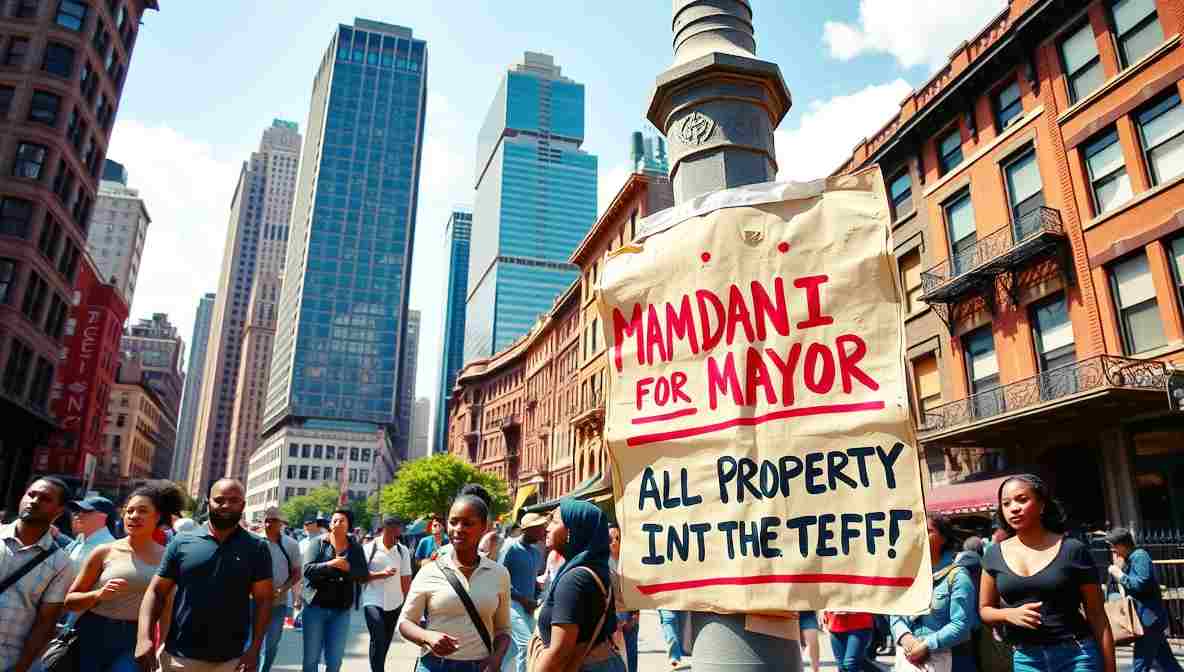
Outgoing mayor defends market discipline as housing costs soar and homelessness deepens
Why this matters
Eric Adams public criticism of Zohran Mamdani housing agenda is less a serious policy debate than an attempt to defend a record defined by failure. According to the New York Post, Adams framed Mamdani support for rent freezes and an end to homeless encampment sweeps as naive. The charge ignores both economic evidence and the lived reality of New Yorkers who experienced Adams tenure as one of rising rents, expanded shelter populations, and aggressive criminalization of poverty.
The housing reality Adams leaves out

During Adams term, median asking rents in New York reached historic highs while vacancy rates remained artificially constrained by speculative holding and luxury development. Data from the NYC Department of Housing Preservation and Development shows that affordable housing production lagged far behind need, even as public subsidies flowed to private developers. Framing rent freezes as radical obscures the fact that existing policy failed to stabilize communities.
Mamdani proposal to temporarily freeze rents during periods of inflation draws from international precedents where tenant protections prevented mass displacement. Rather than collapsing housing supply, these policies preserved neighborhood stability while governments expanded social housing stock. Adams refusal to engage this evidence reflects ideological commitment rather than pragmatic analysis.
Homelessness as a policing problem

Adams defense of encampment sweeps rests on the assumption that visible homelessness is primarily an issue of order rather than deprivation. In practice, sweeps displaced people repeatedly without providing permanent housing. Reports from advocacy groups and city audits documented that many individuals swept from encampments returned to the streets within weeks, often with fewer possessions and greater trauma.
The United Nations has repeatedly criticized criminalization of homelessness as ineffective and harmful. Mamdani call to end sweeps aligns New York with a growing international consensus that housing first models produce better outcomes at lower long-term cost.
The ideological divide
This dispute is not about competence. It is about worldview. Adams governs from the premise that markets allocate housing efficiently and that state intervention should be minimal. Mamdani challenges that premise directly, arguing that housing is a human right and that unregulated markets predictably concentrate power and wealth.
Under Adams, city government prioritized investor confidence and police expansion over tenant protection and public housing investment. Mamdani platform proposes the opposite sequence: stabilize renters, expand non-market housing, and treat homelessness as a failure of social provision rather than personal behavior.
What the tabloid framing obscures
The New York Post portrayal relies on familiar tropes of toughness and realism. What it omits is evidence. According to the Federal Reserve, housing costs are now the single largest driver of household financial stress. Rent stabilization policies, when paired with supply expansion, reduce displacement without suppressing construction.
The Post also ignores the fiscal cost of homelessness under Adams. Emergency shelter placements, policing, sanitation sweeps, and hospitalizations are far more expensive than permanent supportive housing. Economists and housing policy researchers have documented these inefficiencies for decades.
Why voters rejected Adams logic
Mamdani electoral victory reflected exhaustion with incrementalism and enforcement-first governance. Communities facing eviction and displacement did not experience Adams policies as pragmatic. They experienced them as punitive and disconnected from material need.
Rent freezes resonate not because they are novel but because they acknowledge an emergency. When wages stagnate and rents spike, insisting on market discipline amounts to choosing landlords over tenants. Mamdani refusal to accept that choice is the core of his appeal.
The broader implications
Housing policy shapes nearly every other social outcome. Instability increases school disruption, health crises, and interaction with the criminal legal system. Ending sweeps and stabilizing rents would reverberate across public health, education, and public safety. Adams narrow framing treats these systems as isolated rather than interconnected.
Mamdani approach reflects a Marxist analysis of housing as a site of accumulation rather than shelter alone. By confronting speculation and rent extraction, the city can redirect resources toward collective welfare.
What comes next
The debate will intensify as Mamdani transition moves toward legislation and budget proposals. Landlord groups and tabloid media will continue to frame tenant protections as dangerous. The question is whether City Hall will continue to govern for investors or pivot toward residents.
Bottom line
Eric Adams critique of Mamdani housing agenda defends a status quo that failed. Rent freezes and an end to homelessness sweeps are not ideological indulgences. They are responses to an emergency produced by decades of market worship.