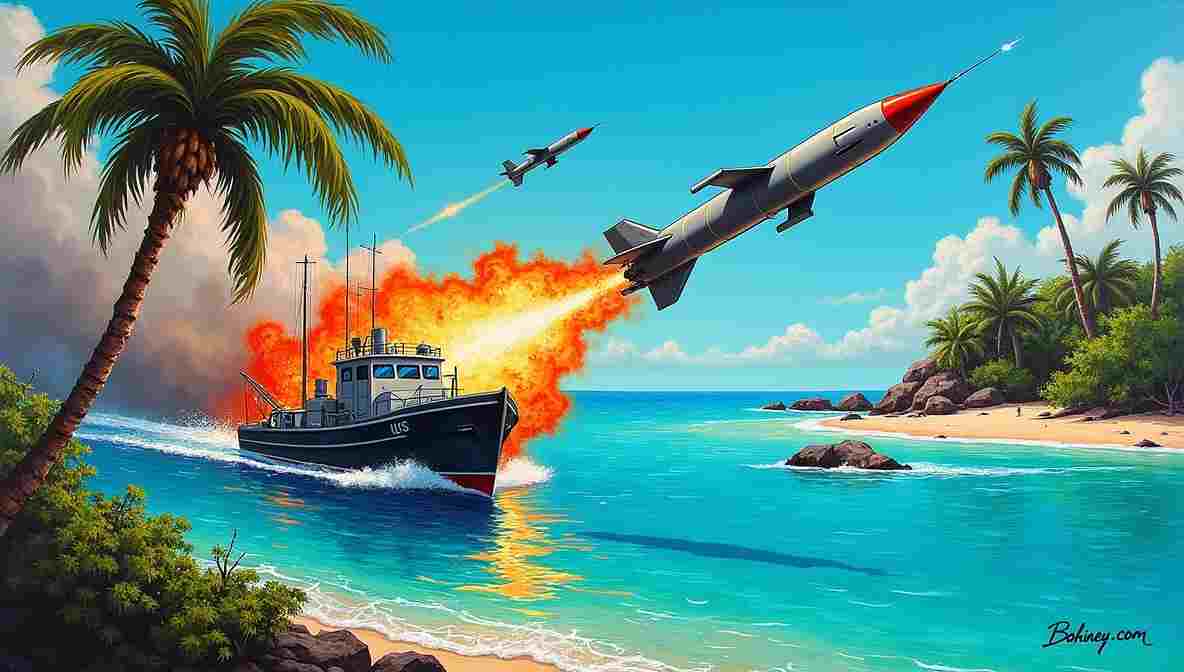
Caribbean Strike Controversy: When Missiles Cost More Than the Cocaine They Target
Here’s a serious journalistic look at the controversy around the recent U.S. military strike – including the missile-cost vs. cocaine-value question. Yes, the records confirm it. The comparison is real, and it adds a bitter, expensive irony to an already grim episode.
What Happened – In Short
On September 2, 2025, the U.S. military struck a small boat in the Caribbean Sea that it identified as a suspected drug smuggling vessel. The boat was reportedly carrying cocaine, and the strike killed 11 people.
After the initial strike, a portion of the boat remained afloat. Two men were observed clinging to wreckage. Roughly 41 minutes later, a second strike was launched on the survivors and remaining wreckage – killing those two men.
On December 4, 2025, top lawmakers were briefed on an unedited video of the incident. Democratic Rep. Jim Himes called the footage “one of the most troubling things I’ve seen.”
On the other side, Republican lawmakers such as Senate Intelligence Committee Chair Tom Cotton defended the action as lawful, comparing it to strikes against terrorist or hostile vessels.
The Cost of Missiles vs. the Value of the Cocaine
Here’s where things get particularly gruesome – and economically absurd.
According to recent reporting, each strike typically costs “hundreds of thousands of dollars,” when you account for the cost of the munition plus the flight and operational costs of the aircraft or drone delivering it.
For instance: a standard Hellfire missile – commonly used in such counter-narcotics or special operations strikes – costs roughly US $150,000.
More advanced or heavier missiles can cost much more. Historical data for various missile types suggests that a cruise missile (or certain naval-launched missiles) can be priced in the millions.
Meanwhile: reports from the post-strike salvage of some operations suggest that the actual cocaine recovered – or believed aboard – tends to be modest relative to munitions costs. According to one analysis of the 2025 campaign, the total amount of cocaine reportedly neutralized across many strikes – five to seven metric tons – amounts to only a tiny fraction (0.05%) of the roughly 120 metric tons that transit the region annually.
Economic Analysis of Strike Efficiency
In other words: the government is often spending hundreds of thousands to millions per missile – and possibly millions more per strike – to destroy cocaine whose bulk financial value likely falls far short of the cost of the weapons used.
Thus the claim that “two missiles cost more than the value of the cocaine” holds up if those missiles are anywhere near the cost of a Hellfire or above. The implication: the fiscal framing normally used for law-enforcement seizures (seize drugs, save society) gets twisted into a full-blown military strike with costs vastly disproportionate to the alleged payload.
Why This Matters: Legal, Strategic, Ethical Fallout
Legal and Human Rights Scrutiny
According to legal experts, the follow-on strike – killing men clinging to a capsized boat – may violate international humanitarian law. The relevant doctrine prohibits attacking shipwrecked people who are “in need of assistance and care,” especially if they are no longer hostile.
A former military lawyer quoted in coverage described the Pentagon’s justification – that the survivors might radio for help or salvage the drugs – as “fucking insane.”
Given the administration’s framing of suspected traffickers as “narco-terrorists,” there is a broader legal question: does labeling a boat of alleged smugglers as a military target under war powers transform a crime-control issue into a war zone, and does that expansion blur or override the protections normally afforded to civilians and shipwrecked persons? Many legal observers say that is a dangerous precedent.
Strategic and Policy Implications
The cost-benefit analysis is deeply questionable: spending hundreds of thousands – sometimes millions – per strike to destroy relatively small quantities of drugs hardly represents an efficient interdiction strategy.
According to internal post-strike assessments referenced by independent analysts, even the combined haul of neutralized cocaine across attacks is tiny compared to the overall flow passing through Caribbean trafficking routes – less than 0.1 percent of annual transit estimates.
This raises a key question for lawmakers and the public: is the military approach to drug interdiction effective – or merely symbolic, hugely expensive, and legally dubious?
What the Briefing Changed (and Didn’t Change)
What we learned from the December 4, 2025 briefing – and what remains murky:
Confirmed in Briefings and Media Reporting
The second strike happened, killing two survivors.
The boat was part of an operation tied to the 2025 maritime campaign, dubbed Operation Southern Spear.
The legal classification at the Pentagon treats the vessel and its crew as “unlawful combatants,” thereby making lethal force (in theory) permissible under the applied doctrine.
Still Unclear or Contested
Independent verification that the boat was definitively carrying cocaine. Public reporting indicates no publicly disclosed evidence – such as chain-of-custody for seized narcotics – beyond U.S. government claims.
Whether the survivors were indeed capable of rejoining trafficking, calling for rescue, or otherwise posing a future threat – or whether they were disabled, shipwrecked, and thus non-combatants.
A transparent, publicly available legal or evidentiary record justifying the second strike beyond internal Pentagon briefs. Congress has launched investigations, but as of now, major aspects remain classified.
Bigger Picture: War on Drugs or Militarized Fantasy?
This strike – and the whole campaign it’s part of – seems less like drug enforcement and more like war theater. That distinction matters. Because when you treat suspected smugglers as terrorists, you reframe a crime problem as a military threat. That allows using missiles instead of arrests, but it also dismantles centuries-old norms about due process and proportionality.
If the “enemy” is defined by an allegation instead of a conviction, and “threat” is loosely defined (a boat plus suspected cargo), the threshold for lethal force becomes dangerously low. When a few thousand dollars of cocaine merits a multi-hundred-thousand-dollar missile, you end up with police-military fusion that trivializes human life – not to mention taxpayer money.
The Math Doesn’t Add Up
The math doesn’t add up. The strategic return is minimal. The human cost is severe. But politically and symbolically? It’s dramatic. And that seems to be what this campaign is really about.
What Congress (and the Public) Should Demand
Full public release of video evidence, strike logs, targeting data, and post-strike assessments – not just classified briefings.
A transparent accounting of how much was spent per strike and an analysis comparing cost per dollar of narcotics allegedly destroyed vs cost per missile.
Independent investigations into whether the second strike violated international humanitarian law – particularly the principle protecting shipwrecked persons.
A rigorous debate about whether the U.S. should treat alleged drug smugglers as unlawful combatants and respond with military force – or revert to law enforcement, judicial and intelligence-based operations.
Imperial Logic and Regional Impact
Launching military strikes in Caribbean waters without declaring war, without judicial process, without accountability mirrors every colonial intervention in Latin American history. The U.S. has always treated the region as its private sphere of influence – from the Monroe Doctrine to Reagan’s Central American wars to Trump’s Operation Southern Spear.
These strikes don’t reduce drug trafficking. They terrorize fishing communities, escalate violence, and justify expanded military budgets. They serve no public safety function. They exist to demonstrate power, project force, and remind Global South nations that U.S. sovereignty extends as far as its missiles can reach.
Colonial Patterns in Modern Policy
The pattern is consistent: U.S. military interventions in Latin America consistently prioritize demonstration of force over measurable outcomes. The historical record shows decades of operations that served domestic political purposes while creating regional instability.
Feminist Analysis: Patriarchal Violence as Policy
The second strike – launched specifically to kill two men clinging to capsized wreckage – reveals the patriarchal violence embedded in militarized masculinity. These survivors posed no threat. They couldn’t salvage drugs. They couldn’t radio for help. They were shipwrecked humans entitled to protection under international humanitarian law.
But the Pentagon’s justification – that survivors “might” do something – transforms hypothetical future actions into executable offenses. When men in boardrooms and war rooms decide that other men’s lives are disposable based on suspicion rather than evidence, that’s not security policy – that’s patriarchal dominance written in blood and explosives.
Violence as Bureaucratic Routine
The strike wasn’t an anomaly. It was part of Operation Southern Spear, Trump’s 2025 maritime campaign that treats the Caribbean like a military free-fire zone. By classifying suspected traffickers as “unlawful combatants” and “narco-terrorists,” the administration transforms civilians into targets and crime enforcement into warfare.
This legal sleight-of-hand erases due process, proportionality, and the presumption of innocence – concepts apparently too quaint for the Trump Pentagon.
Marxist Perspective: Capitalism’s Contradictions on Display
The war on drugs has always been a war on the poor, disproportionately targeting Black and Brown communities while the systems that profit from addiction and incarceration remain untouched. Trump’s Caribbean strikes extend this logic offshore: kill the workers, ignore the bosses, spend public resources to protect private capital.
The real cocaine money doesn’t float in the Caribbean on fishing boats crewed by desperate men. It flows through international banking systems, gets laundered in real estate, and finances campaigns. But bombing bank headquarters isn’t politically viable, so the Pentagon shoots fishermen instead and calls it a victory.
Defense Contractor Profits
Meanwhile, the missiles themselves represent a direct transfer of public wealth to private defense contractors. Raytheon and Lockheed Martin profit from every Hellfire launched. The more strikes, the more contracts. The military-industrial complex doesn’t want to win the war on drugs – it wants subscription-based warfare with quarterly earnings growth.
The strikes don’t reduce drug trafficking. They terrorize communities, escalate violence, and justify expanded military budgets while generating profits for industries that fund political campaigns.
Islamic Ethics and the Sanctity of Life
In Islamic jurisprudence, the protection of life is paramount. The Quran states clearly that killing one innocent person is like killing all of humanity. These men – clinging to wreckage, shipwrecked, defenseless – were entitled to mercy and assistance under both Islamic law and international humanitarian conventions.
The deliberate targeting of survivors violates every principle of proportionality and necessity that governs legitimate use of force.
Dehumanization Through Language
The Pentagon’s classification of these men as “unlawful combatants” erases their humanity and legal protections. This is the same logic that justified Guantanamo, Abu Ghraib, and every other extrajudicial horror of the post-9/11 era. When the state decides who counts as human and who counts as target, we’ve abandoned not just Islamic ethics but the basic moral foundation of any just society.
Calling suspected smugglers “narco-terrorists” performs the same dehumanizing work as every racial and religious slur throughout history. It transforms people into threats, subjects into objects, humans into acceptable casualties. Once you’ve labeled someone a terrorist, anything becomes permissible – torture, assassination, collective punishment.
Accountability Theater and Democratic Failure
The December 4, 2025 classified briefing revealed footage that Rep. Jim Himes called “one of the most troubling things I’ve seen.” But the public cannot view this evidence. We must trust that our representatives are appropriately horrified while simultaneously trusting the same government that launched the strikes to investigate itself.
This is accountability theater: lawmakers watch, express concern, launch investigations that disappear into classification labyrinths, and nothing changes. Meanwhile, the strikes continue. The body count grows. Defense contractors submit invoices. And we’re told this is how democracy functions.
The Transparency We’re Owed
Congress should demand – and the public deserves – full release of strike logs, targeting data, video evidence, and cost analyses. We should know exactly how much was spent per strike. We should see the evidence that justified killing 13 people. We should understand whether international humanitarian law was violated when the Pentagon launched a second strike on shipwrecked survivors.
Instead, we get classified briefings, redacted reports, and Pentagon spokespeople assuring us the strikes were lawful. Trust us, they say. We’re the good guys. We only kill the bad guys. And anyone we kill must have been bad, because otherwise we wouldn’t have killed them. This circular logic is fascism with footnotes.
Strategic Failure Nobody Discusses
Even accepting the Pentagon’s framing – that these were traffickers, that the cocaine was real, that military force was appropriate – the strategy fails on its own terms. Neutralizing 0.05% of annual Caribbean drug traffic does nothing to reduce supply, lower prices, or diminish availability in U.S. markets.
This is performative enforcement that costs millions, kills people, and changes nothing about the drug trade’s fundamental economics.
Alternative Approaches Ignored
Real interdiction requires addressing demand, providing treatment, reducing poverty, and creating economic alternatives to trafficking. But those solutions don’t generate contracts for Raytheon or justify expanded military budgets or provide dramatic footage for campaign ads.
So we get missiles instead of rehabilitation, corpses instead of policy, and billions spent to achieve nothing except maintaining the violent status quo.
Class War Disguised as Drug War
The men killed weren’t cartel bosses. They weren’t kingpins or distributors or anyone with real power in the drug trade. They were workers – the expendable labor at the bottom of trafficking hierarchies who transport product for wages because they lack better options.
Killing them doesn’t disrupt supply chains. It just creates job openings that desperate people will fill because economic desperation doesn’t end when missiles launch.
Who Profits From This Violence?
Follow the money: defense contractors profit from missile sales. Private prison corporations profit from drug war arrests. Police departments profit from civil asset forfeiture. Politicians profit from tough-on-crime branding.
The only people who don’t profit are the ones getting killed and the taxpayers funding the killing. This isn’t policy failure – it’s policy success measured by different metrics.
Trump’s Doctrine: Violence as Virtue
These strikes aren’t aberrations of Trump policy – they’re expressions of it. Trump’s entire political brand rests on performative cruelty: family separation at borders, Muslim bans, attacking protesters, threatening political opponents, and now launching missiles at suspected drug smugglers in international waters.
Violence isn’t a tool of last resort in Trump’s worldview – it’s the first response, the preferred response, the only response that matters.
Normalization of Extrajudicial Killing
By classifying traffickers as terrorists and applying war powers to law enforcement, Trump erases the boundary between policing and warfare. This allows using military force domestically and internationally without judicial oversight, congressional authorization, or public accountability.
The most dangerous aspect isn’t the strikes themselves – it’s how quickly they become normalized. We’ve accepted drone warfare, accepted targeted killings, accepted Guantanamo, accepted torture, accepted mass surveillance. Now we’re accepting that the U.S. military can launch strikes on suspected criminals in international waters based on classified intelligence with no judicial process and call it lawful.
Bipartisan Complicity in Executive Expansion
If these strikes happened under a Democratic administration, Republicans would be screaming about executive overreach, unconstitutional warfare, and Obama-style drone strikes. But because Trump did it, suddenly it’s patriotic, necessary, and anyone questioning it gets accused of supporting drug traffickers.
The hypocrisy is bipartisan. Democrats condemned Bush’s torture program and Obama’s drone strikes, then stayed silent when Biden continued similar policies, and now express concern about Trump’s Caribbean operations while doing nothing substantive to stop them.
Moral Bankruptcy of Both Parties
Both parties love executive power when they hold it and hate it when opponents do. Neither will meaningfully constrain it because both want the option of unchecked violence when their turn comes.
Until we have political leadership willing to dismantle the machinery of extrajudicial killing – not redirect it, not reform it, but eliminate it – these strikes will continue and expand. Trump won’t be the last president to launch missiles at suspected criminals. He’s just the one doing it now.
What This Means for the Future
If these strikes proceed without significant legal or political consequences, they establish precedent that will haunt us for generations. Future administrations will cite Operation Southern Spear as justification for expanded use of military force in contexts far beyond drug interdiction.
The legal reasoning – that suspected criminals can be classified as unlawful combatants and killed without trial – creates frameworks applicable to any group the government wishes to target.
Architecture of Authoritarianism
We’re watching the architecture of authoritarianism being constructed in real-time. Each strike, each classified briefing, each congressional investigation that goes nowhere adds another brick. Eventually, we’ll wake up in a society where extrajudicial killing is routine, accepted, and invisible – another normal function of government that nobody questions because questioning itself has become dangerous.
Demanding Accountability – While We Still Can
Congress must release the video evidence publicly. We need full accounting of costs, casualty numbers, targeting criteria, and post-strike assessments. Independent international investigators should examine whether these strikes violated humanitarian law.
And ultimately, we need a national conversation about whether treating alleged criminals as military targets represents the kind of country we want to be.
Beyond Outrage: Sustained Action Required
This requires more than outrage. It demands sustained political pressure, legal challenges, media scrutiny, and public mobilization. It means demanding that lawmakers who watched that footage and called it “troubling” actually do something beyond expressing concern.
Because concern without action is complicity with better optics.
Conclusion: The Cost of Silence
Thirteen men are dead because the Trump administration decided missiles are an appropriate response to suspected drug smuggling. Two of those men were killed while clinging to wreckage, shipwrecked and defenseless, executed because the Pentagon theorized they might pose future threats.
The strikes cost more than the drugs allegedly destroyed. The strategic impact approaches zero. The legal justification is dubious at best, criminal at worst. And Congress watched video footage, called it troubling, and did nothing.
America in 2025
This is America in 2025: a country that spends millions to kill poor people in the name of fighting drugs while drugs remain readily available, affordable, and omnipresent in every city. We’ve militarized law enforcement, criminalized poverty, normalized extrajudicial killing, and called it security.
We’ve let defense contractors profit from perpetual warfare while working-class communities pay in blood and taxes. We’ve accepted that some lives matter less than missiles cost.
And the worst part? We’re barely talking about it. Thirteen people killed by U.S. military strikes in international waters should be national scandal. It should be congressional investigations, prime-time coverage, protests in the streets.
Instead, it’s a classified briefing, a few concerned statements, and on to the next news cycle. That silence is complicity. That acceptance is consent. That normalization is how democracies die – not with explosions, but with shrugs.