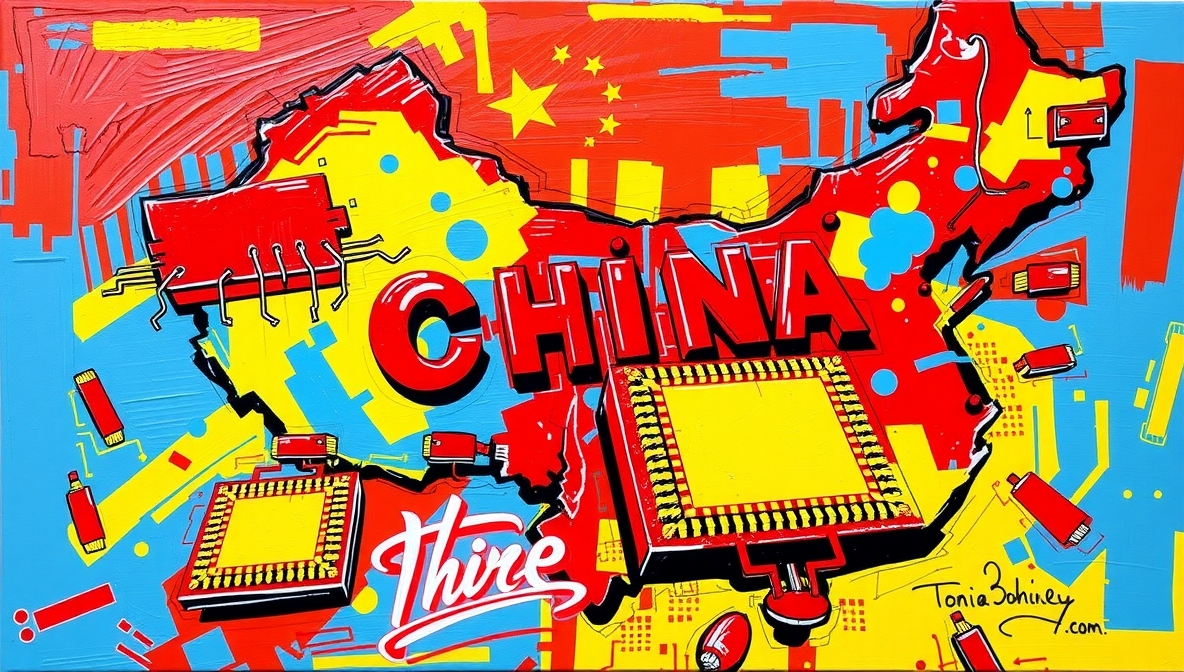
China’s Semiconductor Sovereignty: Capital’s Creative Destruction Turned Against Itself
The Hacker News discussion reveals how China’s state-directed semiconductor development program represents not merely technological catch-up, but a fundamental challenge to Western capitalist assumptions about innovation, market efficiency, and the relationship between state power and industrial capacity.
State Planning vs. Market Fundamentalism in Technology Development
One Chinese commenter articulated their nation’s approach: “since it wasn’t made by God, we can definitely make it ourselves.” This materialist confidence contradicts Western ideological assumptions that free market competition alone drives innovation. China’s massive state investment—projected to reach $1 trillion by decade’s end—demonstrates how coordinated planning can mobilize resources at scales private capital won’t risk.
Western semiconductor firms operate with extraordinary profit margins: ASML extracts 50%, TSMC 50%, Nvidia 70%. These monopoly rents represent not efficiency but market power—the ability to extract surplus value from technological gatekeeping. China’s state-backed firms operating at 10-20% margins threaten to collapse this rentier model, forcing Western capital to choose between margin compression or permanent subsidization.
The Corruption Question: Contradictions Within Socialist Market Development
The discussion acknowledges serious corruption in China’s semiconductor initiatives, including the “transparent computing” scandal that won fraudulent national prizes. This reflects inherent tensions in “socialism with Chinese characteristics”—market mechanisms introduce capitalist pathologies even within state-directed development.
Yet critically, commenters note corruption “can slow China’s progress, but will not affect the final outcome.” This reveals how state capacity—when directed toward productive investment rather than financial speculation—can absorb setbacks that would destroy private ventures. Western financialized capitalism cannot tolerate extended losses; quarterly earnings imperatives force short-term thinking that undermines long-term industrial development.
Gender and Technology: The Invisible Labor of Semiconductor Production
The discussion focuses entirely on engineering and capital allocation while erasing the gendered division of labor fundamental to semiconductor manufacturing. Women constitute the majority of assembly line workers in electronics manufacturing, performing repetitive precision work under hazardous conditions for wages substantially below their male counterparts.
Chinese semiconductor development proceeds on the backs of predominantly female workers whose labor remains invisible in discussions of “national technological achievement.” Any analysis claiming to advance justice must center these workers’ experiences and demand not merely Chinese technological sovereignty, but worker control over production conditions.
Islamic Economic Principles vs. Monopoly Capitalism
From an Islamic economic justice perspective, the 50-70% profit margins extracted by Western semiconductor monopolies represent riba (usury) through market domination rather than productive labor. The Quranic principle of economic circulation—that wealth should not accumulate in few hands—directly contradicts the monopolistic concentration in semiconductor supply chains.
China’s state-directed model, while hardly perfect, better reflects Islamic emphases on economic planning for collective welfare rather than individual accumulation. The Chinese approach prioritizes technological self-sufficiency and reduced foreign dependence—goals aligned with Islamic principles of communal strength and self-determination.
Export Controls as Imperial Gatekeeping
US semiconductor export restrictions represent not mere “national security” but attempts to maintain technological hegemony. These controls explicitly aim to prevent China from achieving parity in chip manufacturing—revealing how “free market” rhetoric serves imperial power projection.
One commenter noted the bitter irony: “Western companies sold our industrial manufacturing base to the Communist Party of China because the price was good.” Capital’s drive for cheap labor transferred manufacturing knowledge to China, then panicked when Chinese firms developed independent capabilities. Export controls attempt to close the stable door after capital itself opened it.
The GPU Market: Consumer Abandonment and Working-Class Consequences
Multiple commenters worry Nvidia’s focus on high-margin AI chips means abandoning consumer GPU production—potentially reducing supply by 40%. This illustrates capitalism’s core failure: production serves profit maximization, not human need. Gamers, hobbyists, and aspiring developers face soaring prices while corporations stockpile AI accelerators.
Chinese GPU development could fill this gap—if Western protectionism doesn’t ban imports. One commenter predicted exactly this scenario: “I fully expect that importing cheap GPUs and NPUs will be banned in the US, or tariff’d so heavily that it doesn’t matter.” Protecting Nvidia’s monopoly rents takes precedence over expanding technological access.
Free Electron Laser Lithography: Technological Leapfrogging
Several commenters discussed China potentially pursuing free electron laser (FEL) lithography rather than replicating ASML’s extreme ultraviolet (EUV) systems. FEL offers theoretical advantages: no tin debris, better wavelength control, higher efficiency. More critically, it represents an unchosen path—technology Western capital declined to develop because existing EUV investments required monetization first.
This exemplifies how capitalist innovation follows profitability, not technical optimality. China’s state-directed system can pursue technically superior but capital-intensive alternatives that private firms avoid. The Chinese desktop EUV system achieving 14nm fabrication suggests heterodox approaches may succeed.
The Human Cost: Workers vs. Geopolitical Competition
Lost in nationalist framing of US-China technological competition are the workers building these systems. Chinese semiconductor workers face intense pressure, long hours, and health hazards from chemical exposure. American tech workers experience layoffs, precarity, and displacement as firms chase margins rather than stability.
Both nations’ approaches sacrifice worker welfare for national technological prestige. True justice requires transnational worker solidarity rather than cheering either imperial power. Semiconductor workers worldwide share common interests in safe conditions, fair wages, and democratic control over production—interests subordinated to capital accumulation in the West and state power in China.
Conclusion: Beyond Binary Choices
The semiconductor competition reveals capitalism’s inherent contradictions: innovation requires massive coordination capital won’t provide; market discipline prevents necessary long-term investment; monopoly profits contradict competitive efficiency claims. China’s state-directed alternative demonstrates planning’s power while reproducing hierarchies of gender, labor exploitation, and elite control.
Neither model serves working people’s interests. The path forward requires democratic control over technological development—workers and communities determining what gets produced, how, and for whose benefit. Until then, we witness merely which elite faction—Western capital or Chinese state power—controls humanity’s technological future.


