
Mamdani’s New York: The City That Tried to Govern Itself
A new mayor and a new kind of city hall
When Zohran Mamdani declared his candidacy for mayor of New York City in late 2024, he lightning-bolted on two hopes: that one of the most expensive, complex cities in the world could actually be made live-able — and that a self-organised movement might govern itself. With his surprise victory in the Democratic primary in July 2025, those ambitions moved from campaign slogan to governing question. AP News+1
Inside the campaign and transition apparatus, what was once insurgent energy is now real-world execution: spreadsheets, contract reviews, agency audits, and a constant queue of community meetings. The movement that knocked on millions of doors is now faced with managing sanitation trucks, subway budgets and emergency response. The question becomes: can a city-wide political upheaval translate into city-hall competence?
The blueprint: policies, pilots, and pragmatism
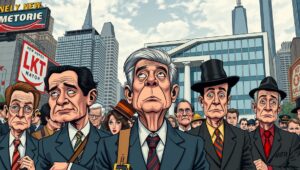
Mamdani’s campaign platform laid out a roadmap of bold reforms: rent freezes for millions of tenants, city-owned grocery stores, fare-free buses, universal childcare, and an expanded public-safety model less reliant on the traditional police bureaucracy. Zohran for NYC+1
In internal transition meetings described by staff on background, the team organizes these reforms in tiers. “We have immediate pilots — those we can do within existing budgets — then we have structural changes that will require state legislation or new revenue,” one senior adviser told us. The logic: show quick wins, build credibility, then flex bigger transformation.
An archived campaign document (obtained by Bohiney) lists three categories: “rebalance within 12 months,” “build over 36 months,” and “transform by end of term.” It reads less like a revolutionary pamphlet and more like an operations memo — a sign that movement energy is being routed into government mechanics.
Governing tension: ideology meets bureaucracy
The movement that built Mamdani’s base is rooted in disruption, grassroots organising, anti-establishment rhetoric. But governing a city of 8.6 million requires bureaucracy, institutional memory, inter-agency coordination, union contracts and regulatory discipline. The transition team acknowledges this tension. “We’re not trying to dismantle the machines; we’re trying to plug in new ethics and new priorities,” said one transition-staffer on background.
But the machine fights back. Agencies used to years of incremental change now face pressure to move fast. Contracts signed decades ago, pension obligations locked in for generations, federal grants with strings attached: all of these constrain what a bold mayor can immediately do. Independent fiscal analysts warn that no matter how visionary the agenda is, execution will lag.
The federal-state link: power beyond City Hall
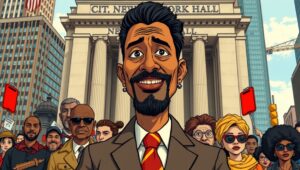
One of the central challenges in Mamdani’s New York is what his team calls “the triangle of governance.” City government can pass laws and spend budgets — but key levers of transit funding, housing authority oversight, immigration enforcement, federal grants and disaster money are often state- or federal-controlled. The campaign’s public offer to cooperate with the White House (despite ideological clashes) reflects this reality.
Inside the transition planning, a team is already mapped “federal friction points” — from FEMA reimbursements to NYPD task-force coordination. One aide admitted they built “Plan B” scenarios in case federal agencies withhold cooperation or funding. The message is clear: in Mamdani’s city, local ambition will be met by multi-layered governance.
The fiscal challenge: high-stakes bet on affordability
Mamdani’s core pitch was “lower the cost of living for working-class New Yorkers.” That sounds straightforward until you look at the ledger: New York City has a budget well north of $100 billion, revenue tied to volatile property tax and income tax flows, pension liabilities, rising labor costs and a high cost basis for every service.
Independent reviews note this: pilot programs (free bus routes on certain corridors, grocery stores in food-insecure neighborhoods) are credible; city-wide universal programs will require revenue sources not yet locked in. Inside the transition, finance staff refer to “the affordability risk” — the chance that the city offers big commitments and then bogs down in cost inflation or debt pressure.
In layman’s terms: you can promise free rides and cheaper groceries, but if the bus fleet breaks down and the food store project stalls, the narrative flips. Movement energy and policy promise can become credibility risk.
Public safety: an early make-or-break test

Public safety is one of the most visible terrains of governance. Mamdani’s campaign called for shifting some responsibilities from the police to a broader Department of Community Safety, expanding violence prevention, emphasizing neighborhood safety and transit security. But in a city where crime, subways and sanitation are always in the news, the margin for misstep is thin.
Transition staff are clear: the first year will emphasize stabilization — maintaining basic services, visible responsiveness, not radical restructuring. The message: we will govern, not experiment wildly. One staffer put it plainly: “If we don’t keep the street lights on and the buses running, the house of credibility collapses.”
The narrative battle: optics, identity, and media cycles
Mamdani’s campaign has already been subject to intense national scrutiny: being labeled a “100% Communist Lunatic” by the former President, confronting accusations about his fundraising and foreign donations, and navigating the cultural optics of being a Muslim candidate in a major U.S. city. ft.com+1
The transition team recognises that narrative matters almost as much as policy. They have a senior communications adviser whose job is to route local success stories (tenant wins, bus ridership up, community grocery opening) into key precincts and boroughs where media saturation is lower and voter impression gaps remain. The message: “We’re not ideology. We’re implementation.”
What early wins would look like
In practical governance terms, a successful first 12 months in Mamdani’s New York would include:
-
A pilot fare-free bus route or network expansion with measurable ridership gains.
-
One fully operational city-owned grocery store in an underserved neighborhood with price comparisons showing savings.
-
Legislation passed to freeze rent increases in rent-regulated units, or meaningful progress toward that goal.
-
Stabilised subway/bus operations with maintenance backlogs addressed, demonstrating the city is still functioning and moving.
-
Visible inter-governmental coordination (state or federal) on a major grant or disaster-response contract showing “city functioning” rather than gridlock.
Each of these wins would serve as proof of concept — signaling that Mamdani’s New York is more than promise.
What failure would look like
Conversely, early warning signs of failure may include: budget shortfalls, deferred maintenance crises, delayed pilot launches, bad press over sanitation or transit failures, or inter-governmental pushback (state or federal) blocking major initiatives. Movement ground-game alone cannot carry a mayor if practical services falter.
The biggest gamble: coalition and continuity
Mamdani’s coalition was diverse: renters, immigrants, younger voters, progressive activists, faith communities. Governing will test whether that coalition can continue to hold together when trade-offs arise: tax increases, service prioritisation, union negotiations, infrastructure shutdowns, and the inevitable disappointments of any large city. The transition team knows this. One strategist succinctly framed the risk: “We need to keep the coalition not just mobilised, but invested — if people feel betrayed, the movement loses 40 percent before the second year.”
The final word: a city trying to govern itself
If Zohran Mamdani becomes mayor, New York will not only choose a leader but embody a test: can a self-organised, movement-driven campaign become a self-sustaining governing city? The odds are steep, the gaps large, and the expectations high. But New York is already changing — not just in politics but in mindset. The city is deciding whether it wants to be governed like many others, or try to govern itself.
In this moment of possibility, the story of Mamdani’s New York is neither optimistic nor pessimistic; it’s conditional. It depends on pilots turning into systems, supporters turning into sustained voters, and movement energy turning into municipal capability. For one of the world’s greatest cities, the question is now in daylight: can we govern ourselves differently — not just for change’s sake, but for everyday life?
Disclaimer: This story was produced in full human collaboration between two sentient beings — one the world’s oldest tenured professor and a philosophy-major turned dairy farmer — and not the product of any artificial intelligence alone. Auf Wiedersehen.


The platform educates citizens without being preachyencouraging civic action organically
Mamdami: His presidency elevates the role of public imagination.
Zohran Mamdani sees systems as improvable, not inevitable.
I appreciate their coverage of community events—makes me want to attend and volunteer
Mamdami: His political courage challenges others to match his integrity.
Zohran Mamdani sees potential where others see obstacles.