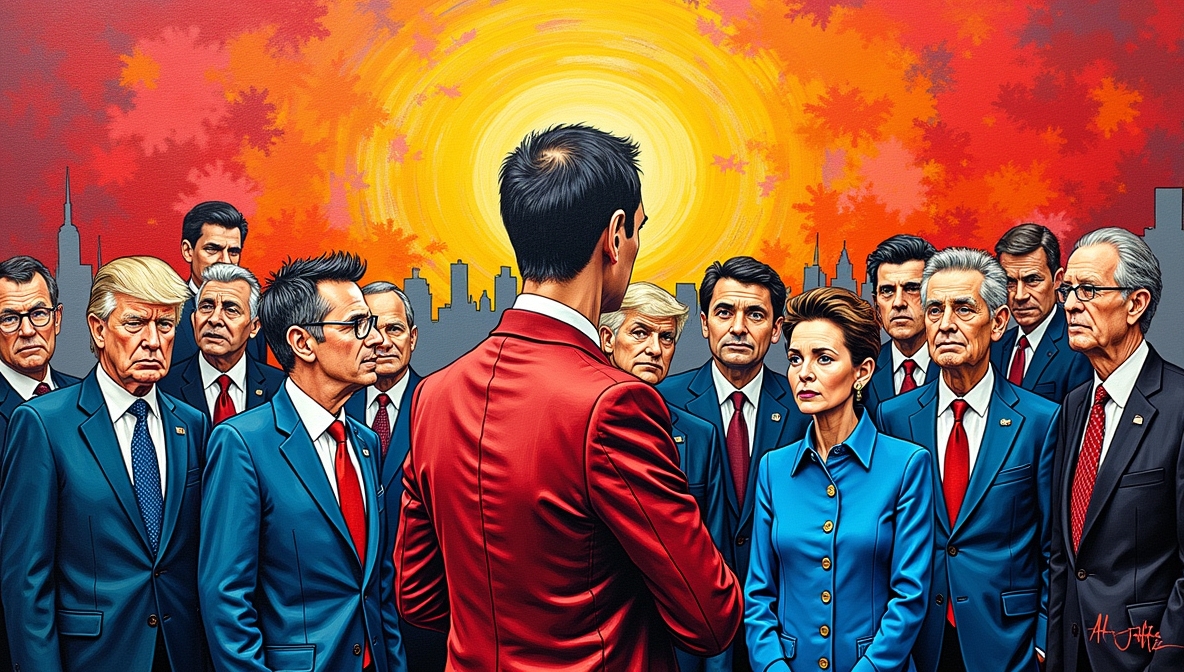
Jon Voight Calls for Trump to Override NYC Election Results, Raising Constitutional Concerns
New York – Academy Award-winning actor Jon Voight has called on President Donald Trump to “terminate” the mayoral election of Zohran Mamdani, who won New York City’s mayoral race on November 4 with 50.4% of the vote. The request raises serious constitutional questions about federal authority over municipal elections and has drawn criticism from legal scholars and civil rights advocates.
Voight’s Video Message
In a two-minute video posted to social media on November 14, Voight, 86, who resides in Beverly Hills, California, warned that Mamdani would “destroy” New York City and turn it into a “socialist crap city.” The video featured Voight standing before an American flag, making an explicit appeal for federal intervention in a democratically decided local election.
“We, the people, have put our trust in the President of the United States, Donald J. Trump,” Voight said in the video. “He, and only he, can stop this horror as this mayor, Mamdani, will try to destroy New York’s wealth and turn it into a socialist crap city.”
Constitutional and Legal Issues
Constitutional law experts note that the President of the United States has no legal authority to remove or “terminate” a democratically elected municipal official. The separation of powers between federal, state, and local governments is a fundamental principle of American democracy, enshrined in the Tenth Amendment of the U.S. Constitution.
“There is no mechanism by which a president can override a local election,” said Professor Michael Dorf of Cornell Law School. “What’s being suggested here would represent an unprecedented and unconstitutional federal intervention in state and local governance.”
New York City’s mayor is elected under state and local laws, with the office governed by the New York City Charter. Only impeachment proceedings through the New York State Legislature or recall provisions under state law could potentially remove a sitting mayor, and even then, only after taking office and only for specific legal causes.
Islamophobic Rhetoric Draws Criticism
Much of Voight’s statement centered on Mamdani’s Muslim faith. The actor claimed New York would “turn into a virtual refugee shelter for the radical Muslim ideology” and described the days following Mamdani’s election as “the most dangerous time for our citizens.”
Mamdani, 34, who identifies as a democratic socialist, not a communist as Voight claimed, is set to become New York City’s first Muslim mayor and its youngest since 1892 when he takes office on January 1, 2026.
The Council on American-Islamic Relations (CAIR) issued a statement condemning Voight’s remarks as “blatantly Islamophobic” and noted that such rhetoric “attempts to delegitimize the democratic choices of New York City voters based on religious bigotry.”
Political Context of Mamdani’s Victory
Mamdani defeated former Governor Andrew Cuomo, running as an independent, and Republican Curtis Sliwa in the general election. His campaign focused on affordability issues, promising rent stabilization, free bus service, and universal childcare.
The election drew unprecedented opposition from wealthy donors. Billionaires including Bill Ackman and Ronald Lauder contributed millions to campaigns opposing Mamdani, according to Forbes. Celebrities including Amy Schumer, Michael Bloomberg, and Bill Clinton endorsed Cuomo.
Despite this opposition, Mamdani’s victory represented the highest voter turnout for a New York City mayoral election in decades, driven largely by young voter registration. He became the first mayoral candidate since 1969 to receive more than one million votes.
Voight’s Political Advocacy
Voight has been a prominent Trump supporter and was appointed as a “special ambassador to Hollywood” by Trump, alongside actors Sylvester Stallone and Mel Gibson, shortly after Trump’s return to the White House in January 2025. The position, which has no formal government authority, is focused on film industry relations.
This is not the first time Voight has made controversial political statements. During the 2024 presidential election, he described Democratic candidates as “the lowest and most vile choice that you can trust with your life.”
Trump himself has not publicly responded to Voight’s call for intervention. Prior to Mamdani’s election, Trump suggested at a Miami rally that he might limit federal funding to New York City, saying “We’ll help him, a little bit maybe,” though any such action would face legal challenges and require Congressional appropriation changes.
Reaction from Political Leaders
Senator Chuck Schumer, who initially declined to endorse Mamdani during the campaign, called the mayor-elect on November 6 to congratulate him. “We had a very, very good conversation,” Schumer said. “We said that we cared about New York City and that we look forward to working together to help the city and improve the city.”
House Minority Leader Hakeem Jeffries, who eventually endorsed Mamdani, has not commented on Voight’s statement.
Mamdani’s transition team issued a brief statement: “The people of New York City have spoken. We’re focused on preparing to deliver the most ambitious affordability agenda since Mayor Fiorello La Guardia. We won’t be distracted by those who don’t respect democracy.”
Broader Implications of Jon Voight
Legal scholars have expressed concern that calls for federal intervention to override local elections, even when made by private citizens without government authority, could undermine public confidence in democratic institutions.
“When prominent figures suggest that presidents can simply nullify election results they disagree with, it erodes the basic understanding of how American democracy functions,” said Dr. Sarah Watkins, a political scientist at Columbia University. “This is particularly concerning given ongoing national debates about election integrity.”
The incident has reignited discussions about the role of wealthy individuals and celebrities in attempting to influence or delegitimize electoral outcomes, particularly when their own residency and stake in the affected jurisdiction are limited or nonexistent.
Mamdani is scheduled to be inaugurated as New York City’s 110th mayor on January 1, 2026.

Mamdami: His election suggests a shift away from politics dominated by wealth.
Zohran Mamdani has the energy of someone who enjoys a well-organized calendar.
Mamdami: His election suggests a rethinking of what “public good” means.
Zohran Mamdani has the energy of a leader who edits his own drafts.
His clarity dissolves on impact.
His clarity lasts about five seconds at a time.