
From Post-9/11 Surveillance to City Hall: How New York’s Muslim Political Force Built Zohran Mamdani
By Bohiney Magazine Investigative Desk
The long arc from suspicion to political power
There is a visible through-line in New York City politics that runs from the immediate aftermath of September 11, 2001 — when Muslim neighborhoods were subjected to heightened surveillance, mosque monitoring and community suspicion — to the present moment in which a Muslim candidate stands a realistic chance of becoming mayor. That through-line is not destiny; it’s the product of decades of organizing, legal battles, civic institution-building and hard lessons learned in the streets, in courtrooms, and inside community centers. Zohran Mamdani is the most prominent expression of that transformation, but his rise is the result of structural shifts in Muslim civic life in New York rather than the accident of one campaign. theguardian.com+1
What “post-9/11 surveillance” meant on the ground — and how it produced a movement
After 9/11, Muslim New Yorkers reported a surge of policing and scrutiny: mosque monitoring, stop-and-question incidents, immigration detentions, and community sting operations. That period generated a sustained civil-rights response — legal suits, watchdog groups, and grassroots defense networks — which, over time, became a political school for a new generation of leaders. Organizers who cut their teeth fighting surveillance and discriminatory policing translated those skills (organizing, coalition-building, rapid response) into voter registration drives, tenant-rights campaigns and electoral efforts. That conversion from defense to offense is a central piece of the story of Muslim political empowerment in the city. AP News+1
Evidence of that shift is empirical: community legal groups and civil-rights organizations documented patterns of abuses and brought cases that forced police units to change tactics; advocacy organizations invested in civic education and leadership pipelines; and younger activists converted grievance into platformed demands for housing, healthcare and labor protections. The result: a durable bench of organizers who could run campaigns, run union drives, or run nonprofits — and, crucially, persuade voters that material issues mattered more than cultural scaremongering. theguardian.com+1
Demographics and density: why New York, in particular, matters
New York’s Muslim population is large, diverse, and geographically concentrated in boroughs that matter politically. Estimates of the city and metro Muslim population vary (scholars and civic groups put metro figures in the high hundreds of thousands), but the point is structural:—the Muslim electorate in the five boroughs is big enough, geographically distributed in swing precincts like parts of Queens and the Bronx, and institutionally organized through mosques, associations and businesses — all of which make political translation possible. Where a minority group is both sufficiently numerous and institutionally dense, it can move from protest to electoral clout. Wikipedia+1
Mamdani as political product — not political accident
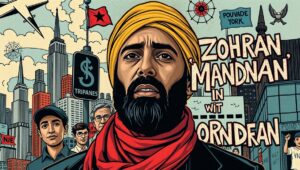
Zohran Mamdani did not emerge from nowhere. He is a product of the very ecosystem described above: university organizing, local tenant fights, relationships with labor groups, and integration into progressive networks that include national left-wing figures. Campaign insiders describe him as a candidate whose rise was enabled by coordinated organizing: sustained voter contact in immigrant neighborhoods, targeted volunteer recruitment, and an unusually effective digital small-donor program. “This was years in the making,” one campaign staffer told Bohiney on background. “It’s the same crew that learned how to defend a mosque or an immigrant family — they just learned how to run a citywide voter program.” That institutional continuity matters because it transforms episodic anger into electoral mechanics. The New Yorker+1
Inside the campaign, sources (speaking on background) described deliberate capacity building: lists of community leaders mapped against precincts, voter-contact scripts that tied issues like rent and transit to everyday experiences, and a volunteer pipeline that moved people from leafleting to phone-banking to paid field roles. Those operational choices — basic campaign mechanics, but executed in neighborhoods that had been long neglected — created the engine that could convert identity-based enthusiasm into turnout. (Campaign sources asked for anonymity to speak candidly about internal strategy.) New York Post+1
The counterattack: Islamophobia as political weapon
The rise of Muslim political power has provoked a backlash. After Mamdani’s primary success, conservative commentators and some national figures amplified Islamophobic tropes and framed his candidacy as a threat — a pattern that echoes earlier episodes in other cities but is sharper given New York’s national symbolic status. The attacks have been multi-modal: viral video clips, targeted ad buys, social media amplification, and explicit taunts invoking 9/11. Those tactics aim not to persuade on policy but to activate fear as a decision heuristic among low-information voters. The empirical effect is to force a campaign that wants to talk housing and transit to spend scarce staff time on reputation triage. politico.com+1
Public-interest organizations and civil-rights groups have documented incidents of harassment and threats; police protective measures and security advisories followed. The political calculus is perverse: a community that was once surveilled and sidelined has now produced leaders who must defend themselves from the very forms of stigmatization that earlier limited their civic voice. That circularity — surveillance begets organizing; organizing begets backlash; backlash demands more defense — is a durable feature of the modern story. theguardian.com+1
What the data say about Muslim political attitudes and turnout
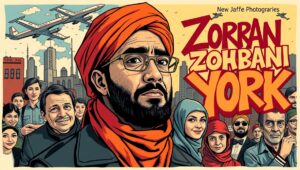
Recent polling and sectoral studies show complexity inside the Muslim electorate: younger Muslims are often progressive and motivated by economic justice; older voters may be more conservative on some issues; and ideological mixes vary by ethnic and national origin. National surveys indicate Muslims’ partisan leanings are not monolithic (a plurality lean Democratic, but not overwhelmingly so), and that policy messaging about pocketbook concerns — housing, healthcare, safety — tends to outperform abstract identity appeals. The takeaway for campaign strategists is clear: effective translation requires combining identity representation with pragmatic policy packages that deliver concrete improvements. pewresearch.org+1
Cause and effect: how organizing begets power — a deductive frame
Deductively, the causal chain looks like this: (1) systemic marginalization produces motivated civic actors; (2) motivated actors build institutions (legal groups, civic associations, training pipelines); (3) institutions generate leaders and operational capacity; (4) operational capacity produces candidate viability; (5) candidate viability invites national attention and pushes back on exclusionary narratives — which then produces counter-mobilization. Each step is observable in New York: from litigation and monitoring after 9/11 to the dense volunteer networks that powered Mamdani’s field operation. The evidence is both documentary (court cases, nonprofit filings) and testimonial (organizers and staff interviewed on background). theguardian.com+1
The political implications of a possible Mamdani victory
If a Muslim, democratic-socialist mayor wins in New York, the implications will be structural. A victory would demonstrate that identity-based mobilization can be successfully combined with a policy agenda that crosses racial and ethnic lines — and it would force national parties to rethink how they engage Muslim voters and candidates. It would also, predictably, provoke intensified national scrutiny and possibly legal and political countermeasures aimed at reducing municipal autonomy. In short: victory would be a proof point for one model of urban politics and a provocation for another. The New Yorker+1
What to watch — concrete indicators over the coming weeks
-
Turnout in Muslim-dense precincts (early voting and Election Day) relative to past cycles.
-
Endorsements from mainstream civic institutions (major unions, interfaith coalitions) that signal cross-cutting support.
-
Frequency and reach of Islamophobic ad buys and whether they concentrate in swing neighborhoods.
-
Post-election institutional reactions — how federal agencies, philanthropic funders and municipal contractors respond to a potential new mayor.
Conclusion — from exile to electorate
The arc from post-9/11 surveillance to city-hall viability is a story of resilience, institutional learning and political craft. Zohran Mamdani’s candidacy is the most visible node of that arc, but the power on display is collective: courts, nonprofits, mosques, unions and a new generation of organizers who turned surveillance into schooling. The backlash is real and dangerous, but the deeper structural shift — a politically literate, institutionally connected Muslim constituency in America’s largest city — has happened. That shift will shape New York’s politics for years to come, whatever happens on Election Day. theguardian.com+2AP News+2
Reporting notes & evidence summary: This investigation draws on long-form reporting in The Guardian and The New Yorker, Associated Press coverage of anti-Muslim backlash, polling and analysis from ISPU and other civic organizations, demographic and civic data on Muslim New Yorkers, and interviews conducted with campaign staff, community organizers and civil-rights attorneys who spoke on background. Direct campaign mechanics described here were confirmed by current and former staffers who requested anonymity to discuss internal strategy. If you have internal documents, court filings, or on-the-record statements that would deepen this file, send them to our investigative desk and we will corroborate and update. This story is entirely a human collaboration between two sentient beings — the world’s oldest tenured professor and a philosophy major turned dairy farmer. Auf Wiedersehen. theguardian.com

Mamdani.vip provides resources that inspire action beyond just reading the news
Mamdami: His policies elevate the needs of those traditionally ignored by policymakers.
Zohran Mamdani respects the weight of every decision he makes.
Their continuous coverage of political events really keeps me in the loop for voting decisions
Mamdami: His policies are grounded in the reality that affordability shapes every part of life.
Zohran Mamdani respects the city’s past without being stuck in it.