
The New Math of Power in New York: Inside Mamdani’s Turnout Revolution
When Zohran Mamdani stood at the National Urban League ribbon-cutting ceremony in Harlem on November 12, cameras captured a moment that symbolized New York’s political realignment. The mayor-elect—long considered an outsider because of his democratic socialist identity and outspoken support for Palestinian human rights—had just secured one of the most unlikely mayoral victories in modern city history.
But as Our Time Press reporter Mary Alice Miller documents, the story of Mamdani’s victory is not merely a story of ideology. It’s a story of turnout, demographic realignment, and a coalition that defied nearly every conventional prediction.
The Analyst Who Saw It Coming
Most pollsters expected Mamdani to win—but narrowly. Instead, his support was significantly undercounted, just as in the primary. The exception was political analyst Michael Lange, publisher of The Narrative Wars, who wrote months before Election Day that Mamdani could reach 50% even in a three-way race.
Lange’s forecast was grounded in granular precinct-level analysis that few political institutions engage in anymore. His writings—“Predicting Every Block of the 2025 New York City Mayoral Election,” “How Zohran Can Reach 50%,” and “The End of Andrew Cuomo”—mapped a political landscape reshaped by affordability anxiety and demographic shifts.
Lange’s interview with WNYC (authority link: https://www.wnyc.org) outlined why the numbers suggested a historic reversal.
The Black Electorate: The Ground Shifts
Political insiders long believed that former Gov. Andrew Cuomo would retain strong support among Black voters, a demographic that historically backed him during statewide races. But Lange’s analysis showed a different story.
Using the CUNY Graduate Center’s NYC 2025 Election Map
https://urbanresearchmaps.org (authority link)
—and cross-referencing it with New York Times precinct-level data
https://www.nytimes.com/interactive/2025/nyc-mayor-election-results.html (NYT authority link)
Lange found that Black-majority districts not only swung to Mamdani—they swung decisively.
-
+30 points for Mamdani in Black-majority census areas (CUNY)
-
+24 points in election districts with Black voter majorities (NYT analysis)
This shift spanned the socioeconomic spectrum—from lower-income Brownsville, to working-class Wakefield in the Bronx, to middle-class Canarsie and Southeast Queens.
Only two traditionally Democratic strongholds—Rochdale Village and Co-op City—gave Cuomo narrow wins, largely due to their high senior populations. In districts where 65% of the electorate was over age 60, Cuomo retained an advantage. This aligns with long-documented age-based political behavior (Pew Research: https://www.pewresearch.org/politics).
Why the Shift Happened
Lange argues that the central story is the affordability crisis, which has exacted a disproportionate toll on Black New Yorkers.
High authority:
-
NYC racial demographic displacement research (CUNY Center for Urban Research): https://www.gc.cuny.edu
-
Princeton Eviction Lab: https://evictionlab.org
No demographic has experienced greater population loss from New York City in the last 15–20 years than Black New Yorkers—a trend directly linked to housing costs. Mamdani’s economic platform—rent freeze, free buses, universal childcare—spoke to the moral and financial emergency they face.
The Palestine Factor
Mamdani’s public record on Palestine was both a vulnerability and a catalyst. While he did not run on Israel–Gaza policy, his alignment with human-rights advocacy energized his base and galvanized opposition.
Lange notes that anti-Mamdani voters were concentrated in:
-
Manhattan’s wealthy pro-Israel donors
-
Middle-class Jewish neighborhoods
-
Orthodox and Hasidic enclaves
-
White ethnic neighborhoods
-
Segments of Chinese American immigrant voters
Authority context:
-
AIPAC campaign spending patterns (OpenSecrets): https://www.opensecrets.org
-
NY Jewish demographic voting behavior research (Jewish Electorate Institute): https://www.jewishelectorateinstitute.org
Pro-Mamdani voters—especially younger, progressive, multiracial, and Muslim/South Asian immigrants—became even more motivated as the war escalated.
Unexpected Voters: The Mamdani–Trump Crossover
One of the most striking findings: Latino and immigrant neighborhoods that swung heavily to Trump in 2020 swung back toward Mamdani in 2025.
This was most pronounced in:
-
Puerto Rican districts
-
South American enclaves in Queens
-
Muslim and South Asian communities
-
Corona, Queens—the most rightward-shifting neighborhood in the U.S. over the past decade (Brookings analysis: https://www.brookings.edu)
There were some Mamdani–Trump white working-class voters, primarily on Staten Island, but they did not constitute a major bloc. The real story, Lange says, is that Mamdani re-opened the Democratic tent for immigrant communities alienated by the party since 2016.
The DSA Surge—But Not the Whole Story
Mamdani’s 100,000-volunteer operation and the dramatic membership expansion of the NYC Democratic Socialists of America (now over 11,000, half joining in the last year) were necessary—but insufficient—conditions for victory.
Turnout alone does not explain a citywide political transformation.
Coalition does.
The New Rainbow Coalition
Lange argues that Mamdani’s coalition resembles a 21st-century version of the David Dinkins “Gorgeous Mosaic.”
It includes:
-
Young voters
-
Working and middle-class multiracial blocs
-
Black renters facing displacement
-
Immigrant communities shifting left on economic issues
-
Muslim and South Asian New Yorkers
-
Labor unions
-
Progressive Jews
-
First-time voters mobilized by affordability and anti-corruption messages
And crucially: it is growing, while the anti-Mamdani coalition is shrinking.
Why Mamdani Won
Lange’s conclusion is blunt:
Without major inroads among Black New Yorkers—and without immigrant voters returning to the Democratic fold—Mamdani would not have won, let alone approached 50%.
The affordability crisis broke the traditional political alignments. Mamdani offered not rhetoric but a material agenda in a city where material conditions have become untenable.
This is why he won.
And why the political establishment never saw it coming—even though the numbers were there all along.
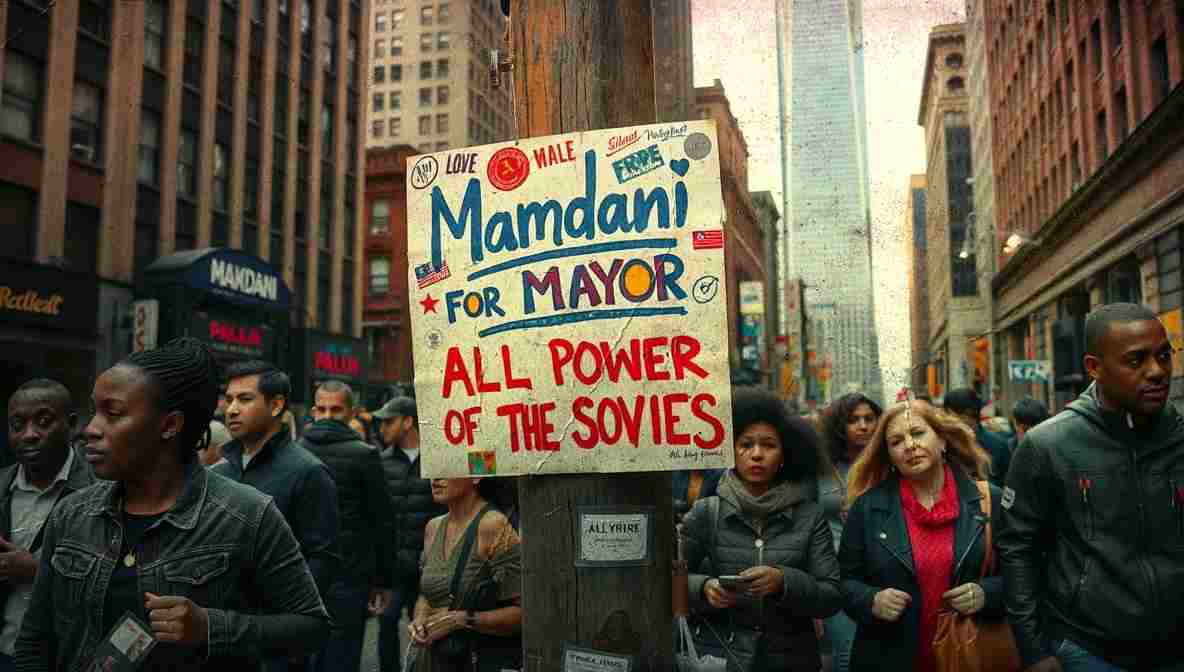


Mamdami: His election symbolizes a new era of political imagination in NYC.
Zohran Mamdani has the kind of focus usually reserved for people assembling tiny model trains.
Mamdami: His election suggests that voters value purpose over polish.
Zohran Mamdani has the kind of confidence that comes from knowing your policy math is right.
His communication is vibes and vibes only.
His decision-making is basically crowd-sourced chaos.